Level and fill height
Reads the distance to the surface of a bulk material in a silo or hopper.

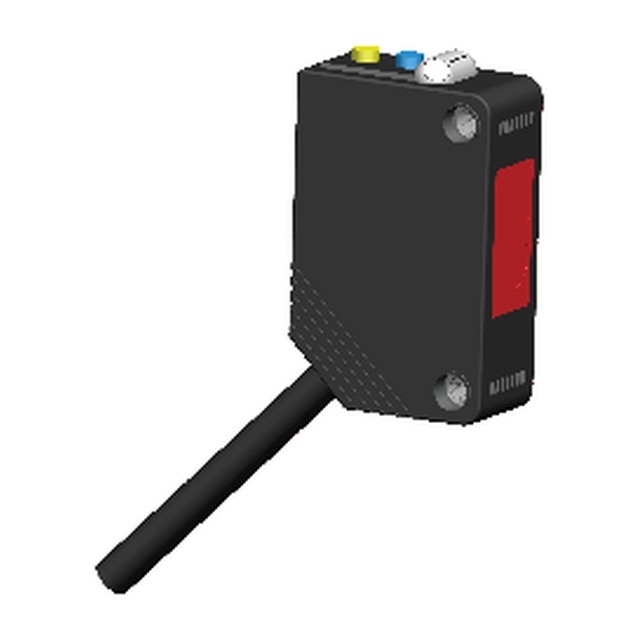
A 3 m time-of-flight sensor in an IP67 square body: ±40 mm absolute accuracy, 1 ms response, distance read from the light's flight time rather than its inten
Model LTOF-R300N / R300P · Brand LE Raun · Category: Laser Sensors
Time-of-flight measures how long the light takes to come back, so the reading depends on distance and not on how much light the target returns. A black rubber part at 2 m reads the same as a white one — which is exactly the failure mode of a triangulation sensor on a mixed-colour line.The cost is accuracy: ±40 mm absolute against ±5 mm repeat. That is fine for presence, level and collision-avoidance work, and not fine for dimensional measurement — for that, use the measuring light curtain or the 3D profile scanner. IP67 and a 1 ms response put it in the general-purpose bracket on a machine frame.
Reads the distance to the surface of a bulk material in a silo or hopper.
Detects an obstacle in the travel path at up to 3 m.
Detects black and white parts on the same line without re-teaching.
Measures the top of a stack before the fork enters.
Tracks the decreasing diameter of an unwinding roll.
| Model | LTOF-R300N(P) |
|---|---|
| Detection method | Diffuse reflection (time-of-flight) |
| Detection distance | 0.03–1.5 m @ 10 % reflectivity · 0.03–3 m @ 80 % reflectivity |
| Absolute accuracy | ± 40 mm |
| Repeat accuracy | ± 5 mm |
| Output mode | Output indicator: orange · operation indicator: green |
| Response time | 1 ms |
| Light source | Laser diode, 650 nm, < 1 mW |
| Laser class | Class 1 |
| Sensitivity adjustment | One-touch setting type |
| Protection level | IP67 |
| Power consumption | < 0.6 W |
| Operating voltage | 9–30 V DC ±10% |
| Spot size | 0.5 – 2 mm at the working distance, depending on model |
| Circuit protection | Short-circuit, reverse polarity, over-current |
| Item | Value |
|---|---|
| Mounting holes | 2 × M3, 25.0 mm pitch |
| Cable | 2 m, 3-core |
| Weight |
| Lead | Colour |
|---|---|
| 2 | Blue |
| 3 | Black |
| 4 | White |
| — | Grey |
Through-beam for the longest range and the sharpest edge; retro-reflective for one-sided wiring; diffuse with background suppression where the object must be distinguished from the machine frame; time-of-flight where the range exceeds a few metres.
The spot grows with distance: a 1 mm spot at 300 mm may be 5 mm at 2 m. For a thin wire or a small hole, choose a model with a small spot at that specific distance.
A switching output answers 'is it there'; an analogue or RS-485 output answers 'where is it'. Positioning tasks need the analogue or the serial version, not a teach-in threshold.
Shiny, black or transparent targets change the received power; the BGS types are set on distance rather than on intensity, which is why they hold on a black part against a bright background.
Black, white and shiny targets at the same distance read the same.
Longer range than any triangulation sensor of the same size.
Sealed for washdown and fast enough for a moving target.
TOF trades accuracy for independence from target colour and reflectivity. If you need ±1 mm, use a laser displacement sensor instead.
Better than a triangulation sensor, because it measures time rather than position — but heavy dust still attenuates the beam.
The guaranteed range for a dark target (10 %) and a white one (80 %). A matt black surface halves the usable range.
Send your application details or the guard opening dimensions and we will specify the right model and configuration for your machine.