Conveyor speed and length
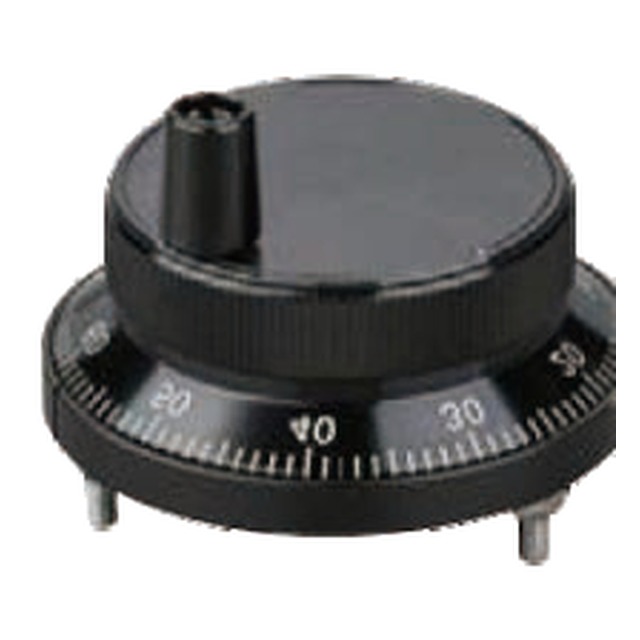
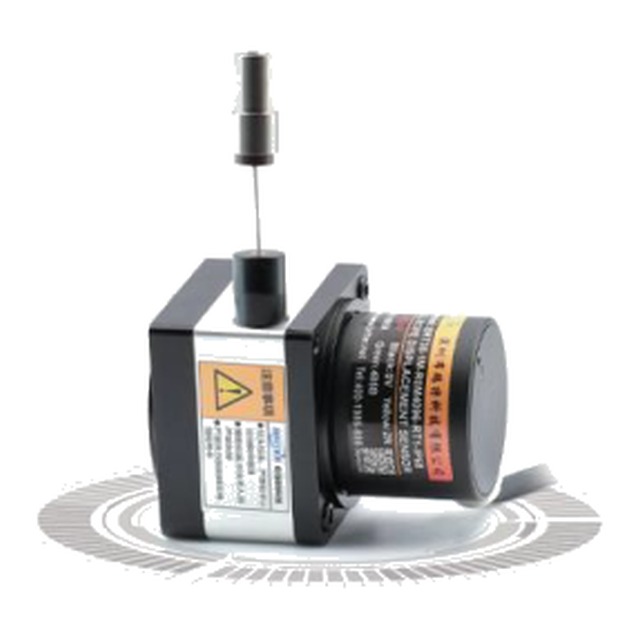
Pulses from a measuring wheel give both the speed and the distance travelled; the Z index re-references the cut position once per revolution.

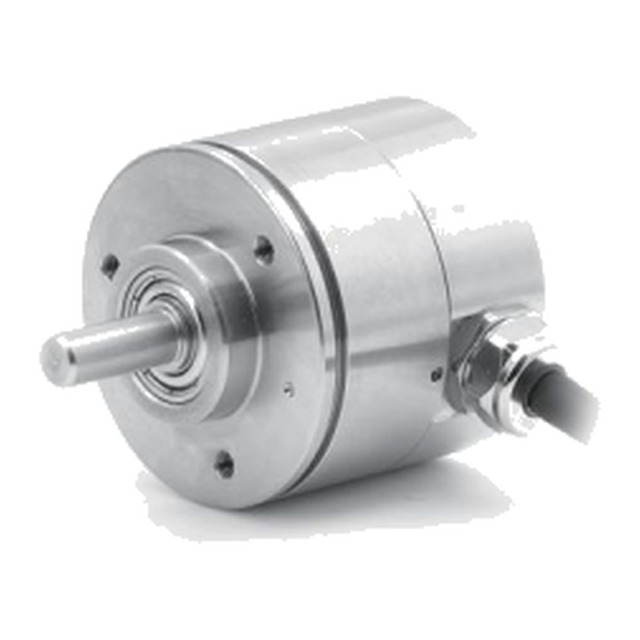
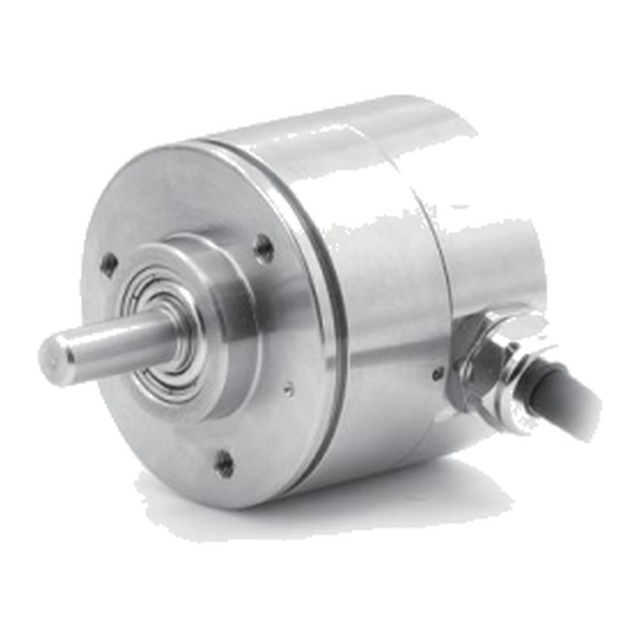
From 50 to 4096 pulses per revolution, A/B/Z with a six-phase differential option, 200 kHz output frequency and 6000 rpm — in solid-shaft, clamp-hollow and b
Model LE25 · LE38 · LE38B · LE50 · LE58 · Brand LE Raun · Category: Encoders & Draw-Wire
An incremental encoder emits a pulse train as the shaft turns. Two channels in quadrature give direction and four counts per pulse period; a third channel, Z, gives one pulse per revolution so the controller has an index to reference against. Resolution is quoted in pulses per revolution, and a four-times decoder sees four times that number of counts.The magnetoelectric discs cover 50 to 4096 PPR and the photoelectric discs 200 to 1024 PPR, which is why the catalogue lists two resolution ranges for the same housing. Magnetoelectric is the better choice where the shaft is hot, dusty or vibrating; photoelectric is the better choice where the disc has to be fine and the environment is clean.The output stage is the other half of the specification. Voltage and open-collector outputs are single-ended and suit a short cable into a PLC input card; complementary, push-pull and line driver are for long cables and for drives that want a differential pair. The six-phase line driver carries A/Ā/B/B̄/Z/Z̄, the three-phase version only A/B/Z.Speed ratings follow the protection class — 6000 rpm for the IP54 bodies, 8000 rpm for the IP68 ones — and the supply is 5 V or 7–24 V DC, with line-driver versions restricted to 5 V. The Φ25 and Φ30 codes run from 1 to 4096 PPR; the larger housings go to 5000 PPR on the order-code table even where the standard disc stops at 4096.
Pulses from a measuring wheel give both the speed and the distance travelled; the Z index re-references the cut position once per revolution.
The six-phase line-driver version feeds a drive that expects a differential A/B/Z pair.
The Z pulse marks one revolution of the feed roller, so the controller can cut at a fixed distance from it instead of from a mark sensor.
A gear-driven encoder turns a rotary valve into a position readout without a linear scale.
Replacing a failed E6A2 or OSS with the same footprint is usually a same-day repair.
| Housing sizes | Φ25 mm · Φ38 / Φ39 / Φ40 mm · Φ50 mm · Φ58 mm |
|---|---|
| Shaft / bore | 4 mm shaft (LE25) · 6 mm shaft (LE38) · 8 mm clamp hollow (LE38B) · 8 mm shaft (LE50) · 10 mm shaft (LE58) |
| Resolution — magnetoelectric | 50, 60, 100, 200, 256, 300, 360, 400, 500, 512, 600, 1000, 1024, 1200, 1250, 1500, 1800, 2000, 2500, 3000, 3600, 4000, 4096 PPR |
| Resolution — photoelectric | 200, 500, 1000, 1024 PPR |
| Output phase | A/B/Z · line-driver six-phase A / Ā / B / B̄ / Z / Z̄ |
| Output stage | Voltage · NPN open collector · PNP open collector · line driver 3-phase · line driver 6-phase · push-pull |
| Max. output frequency | 200 kHz (PNP: 100 kHz) |
| Max. rotating speed | 6000 rpm (IP54 bodies) · 8000 rpm (IP68 bodies) |
| Supply voltage | DC 5 V or DC 7–24 V (line-driver: DC 5 V) |
| Cable outlet | Side outlet · side and rear outlet (LE25, LE38, LE50, LE58) |
| Operating temperature | −40 to +85 °C |
| Protection level | IP54 standard · IP68 waterproof · Ex explosion-proof |
| Resolution | Incremental 100–5000 ppr; absolute up to 17 bit single-turn / multi-turn |
| Output circuit | Push-pull, open collector, line driver (RS422), SSI or RS485 |
| Max. speed | 6,000 rpm (mechanical) |
| Item | Value |
|---|---|
| LE38M | Ø39 mm outside diameter, 8 mm blind hollow bore |
| LE50 | Ø50 mm outside diameter, 8 mm solid shaft |
| LE58 | Ø50 mm outside diameter, 10 mm solid shaft |
| Cable exit | Side exit on all four |
| Max. speed | 8000 rpm single-turn · 3000 rpm multi-turn |
Read the outside diameter, not the model number: the 38 family is Ø39 mm, and the LE58 shares the Ø50 mm body of the LE50 — only the shaft grows to 10 mm. Machine the mounting plate from this row.
| Lead | Colour (typical) |
|---|---|
| 0 V | Blue |
| A / A̅ | White / Green |
| B / B̅ | Yellow / Grey |
| Z / Z̅ | Pink / Red |
| Shield | — |
Incremental for speed, length and simple positioning where the controller homes on power-up. Absolute where the position must be known without a homing cycle — a rotary table, a lift, a valve actuator.
Resolution = travel per revolution ÷ ppr. A 5 mm ball screw with a 2500 ppr encoder gives 2 µm per count before quadrature, 0.5 µm after — finer than the mechanics can hold.
Open collector for a short cable into a PLC, push-pull for a few metres, line driver for long runs or high frequency, SSI/RS485 for absolute multiturn.
Clamp or hollow-shaft mounting removes the coupling and the alignment problem; a solid shaft needs a flexible coupling and a bracket with slotted holes.
Voltage, NPN and PNP open collector, complementary, push-pull and 5 V or 24 V line driver — the stage is chosen by order code, not by a different product.
4096 PPR at 6000 rpm would be 409 kHz, so the 200 kHz limit caps the resolution at speed. The crossing point is about 2930 rpm; below it 4096 PPR is available, above it the usable count is lower.
Single-ended A/B/Z for a short cable into a PLC card; A/Ā/B/B̄/Z/Z̄ where the cable crosses a drive or runs the length of a machine.
The LE0S25 and LE0S30 codes are listed against Omron E6A2 and Nemicon OSS, the LE0S50C against Koyo TRD-J, and the LE0S48 against Tamagawa OIH48 — which is often the reason for the order.
It gives one pulse per revolution. A controller uses it to re-reference the count once per turn, so a missed or extra pulse does not accumulate into a position error over a long run. On a cut-to-length machine the Z pulse is the registration mark.
Because the two figures are limits, not a simultaneous operating point. 4096 PPR is available at low speed and 6000 rpm at low resolution; they cross at about 2930 rpm. Size the counter for the pulse frequency you will actually generate.
C is an NPN open collector, E a voltage output, F complementary, T push-pull, L a 5 V line driver and A a 24 V line driver. Use C or E into a PLC input card, and L or A where the cable is long or the receiver is a servo drive expecting a differential pair.
Send your application details or the guard opening dimensions and we will specify the right model and configuration for your machine.