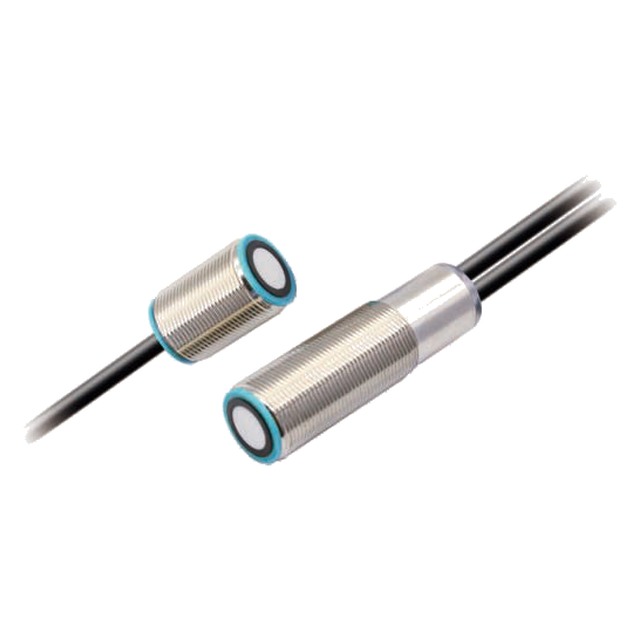
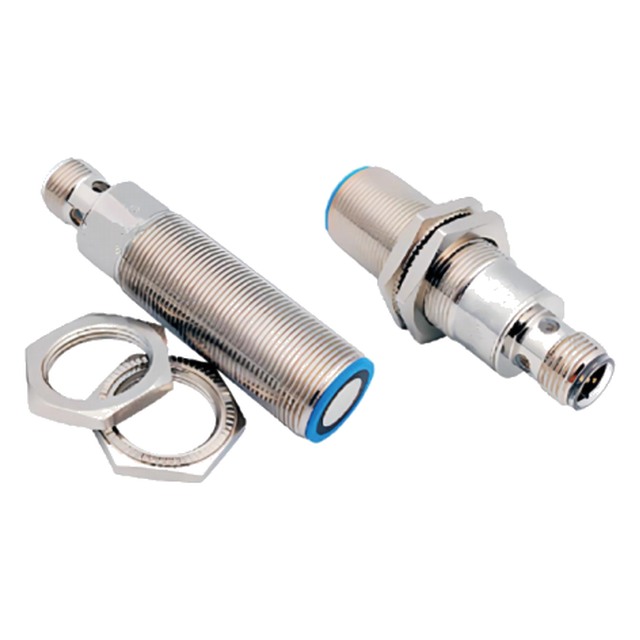
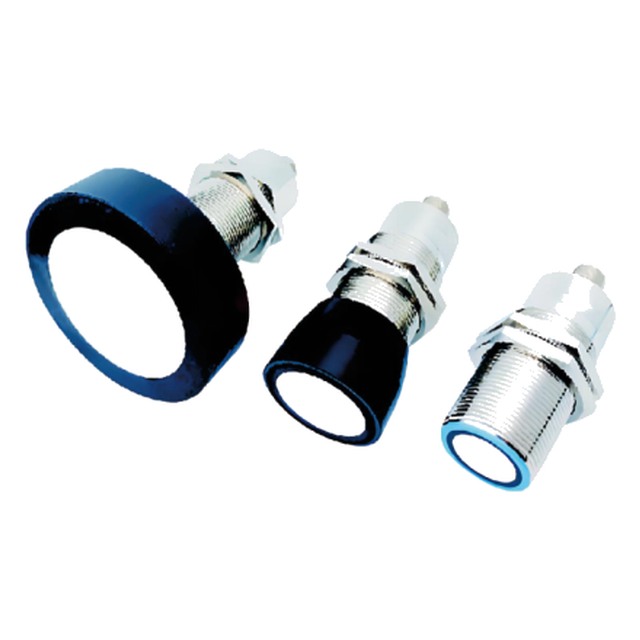
Bottle and container presence
Detects clear PET bottles that an optical sensor would miss because the beam passes straight through.

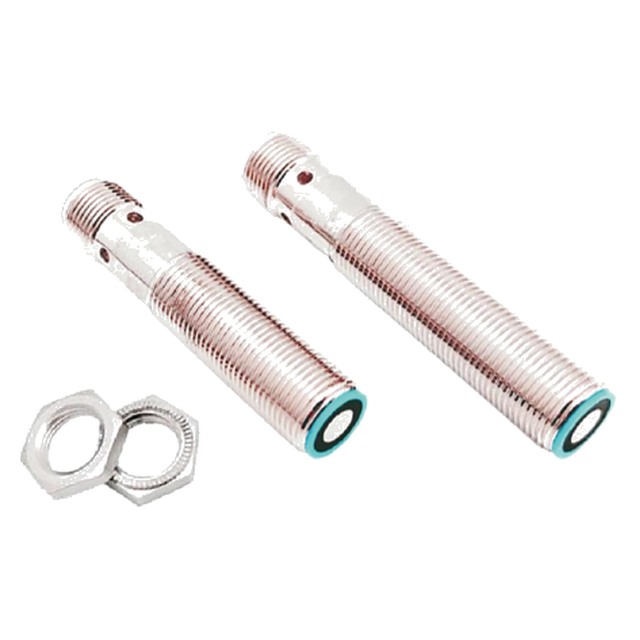
An M12 barrel that reaches 120 mm and an M18 barrel that reaches 200 mm, in switching, current, voltage, RS485 and IO-Link versions, with a 20 mm blind zone
Model LB120-12GM55 / LB200-18GM55 / LB120-12GM65 / LB200-12GM65 · Brand LE Raun · Category: Ultrasonic Sensors
Ultrasonic sensing works by timing an echo. A transducer emits a burst at around 40 kHz, waits for the return, and converts the flight time into a distance. Colour, gloss and transparency do not enter the calculation, which is why the technology survives where optics fail: clear film, black rubber, polished metal, dusty air.The compromise is the blind zone. The transducer cannot listen while it is still ringing from its own pulse, so the first 20 mm of the LB120 / LB200 range is unusable. That is still short enough to mount inside a machine guard, and it is the reason these two series exist alongside the longer LB300 / LB500 / LB1000 bodies, whose blind zones grow to 60 mm.The switching versions use E2/E4 for a single NPN output and E3/E5 for a single PNP output, both normally-open or normally-closed. The analog and bus versions use I for 4–20 mA, U for 0–10 V, R4 for RS485 Modbus-RTU and IO for a push-pull output with IO-Link. All are 10–30 V DC, IP67, and rated for −25 to +70 °C.
Detects clear PET bottles that an optical sensor would miss because the beam passes straight through.
The analog version reports the level in a 120 mm window on a compact reservoir.
Measures how far a web hangs between rollers, which a photoelectric edge sensor cannot do.
An M12 barrel inside the jaw confirms that a part is seated before the clamp closes.
Detects a person in a zone regardless of clothing colour, which is why ultrasonic units are used on automatic doors and in sanitary fittings.
| Series | LB120 (M12 barrel) · LB200 (M18 barrel) |
|---|---|
| Sensing range | 20–120 mm (LB120) · 20–200 mm (LB200) |
| Switching output | E2/E4: 1 switching output, NPN, NO/NC · E3/E5: 1 switching output, PNP, NO/NC |
| Analog / bus output | I: analogue current 4–20 mA · U: analogue voltage 0–10 V · R4: RS485 Modbus-RTU · IO: push-pull, IO-Link supported |
| Blind zone | 0–20 mm |
| Resolution | 0.1 mm |
| Repeat accuracy | ±0.15 % of full-scale value |
| Response time | 18 ms (LB120) · 22 ms (LB200) |
| Switching frequency | 55 Hz (LB120) · 45 Hz (LB200) |
| Operating voltage | 10–30 V DC |
| Ambient temperature | −25 to +70 °C (248–343 K) |
| Protection level | IP67 |
| Housing | Nickel-plated brass barrel, M12 × 1 / M18 × 1 thread, V1 connector |
| Product application | Liquid-level detection, transparent-object detection, human-body detection |
| Principle | Reflected sound pulse; distance from time of flight |
| Beam angle | 8° – 15° half-angle depending on the transducer diameter |
| Temperature compensation | Built in over the full operating range |
| Item | Value |
|---|---|
| Analogue / RS485 / IO-Link types | 67.0 mm overall, 43.0 mm of thread |
| Barrel thread | M12 × 1 (LB120) · M18 × 1 (LB200) |
| Connector | M12 × 1 (V1) at the rear |
| Nuts | Two hex nuts supplied with each sensor |
Both bodies are the same length; only the barrel diameter changes between the LB120 and the LB200. The 10 mm difference between the switching and the analogue versions is the extra PCB for the current loop, and it sits at the connector end — so a bracket cut for the 57 mm body still fits.
| Lead | Colour |
|---|---|
| 2 | Blue |
| 3 | Black |
| 4 | White |
| 5 | Grey |
Every ultrasonic sensor is blind for the first 30–100 mm. If the target comes closer than that, the reading jumps to the maximum — mount the sensor further back or choose a type with a shorter dead zone.
The cone is 8–15° half-angle: at 1 m a 15° cone is 500 mm across. In a narrow tank the walls answer instead of the liquid, which is why standpipes and stilling wells exist.
Soft foam, felt and open-cell sponge absorb the pulse; a surface at 45° reflects it away. Cloth, liquid and granular material are the easy cases.
Analogue for level, RS485 for a bus of sensors, switching for a simple high/low limit. Add the synchronisation lead whenever two sensors can see the same surface.
The short barrels see from 20 mm, which is what lets them be fitted inside a gripper or beside a conveyor without leaving a dead zone the size of a hand.
Fine enough to follow a liquid level or a web sag, not just to answer “is it there?”.
Switching, 4–20 mA, 0–10 V, RS485 Modbus-RTU and IO-Link are all available in the same M12 or M18 housing with a V1 connector.
E2 and E4 are the NPN variants (normally open and normally closed); E3 and E5 are the PNP variants. The number after the E tells you the transistor type and the switching logic, not the range or the housing — those are in the model prefix.
The LB200 rows in the analogue and bus columns are printed as LB200-12GM65 and LB200-12GM55, while the switching column uses 18GM55. The 200 series is an M18 body, so treat the 12GM entries as a catalogue typo and confirm the thread on the order.
For presence at a few hundred millimetres, yes — clothing and skin both reflect ultrasound. It is not a safety device: it has no certified performance level and no self-checking output, so a safety function needs a light curtain or a safety laser scanner.
Send your application details or the guard opening dimensions and we will specify the right model and configuration for your machine.