Forty-station assembly cell
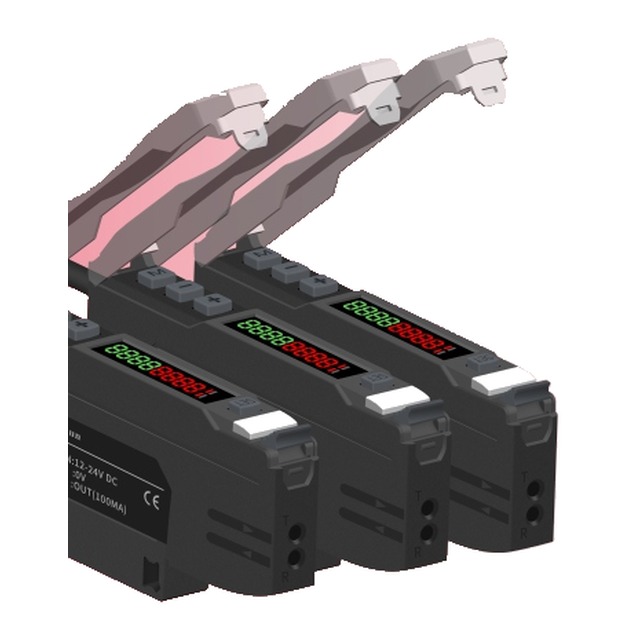
One LG-03IN per station on a backplate, 300 mW each, all on 24 V. The Chinese menu lets the line leader re-teach a station after a fixture change.

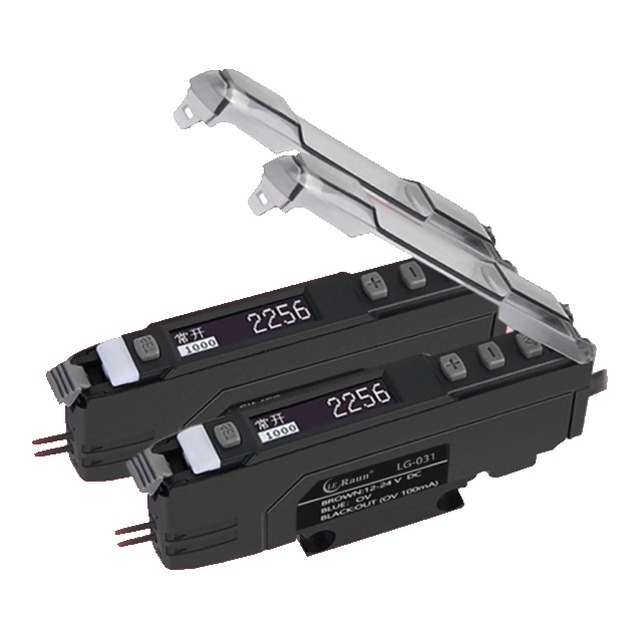
The same fiber port and the same 80 mm body as the LE series, but with a Chinese-language menu and a setting sequence that a line operator can follow without
Model LG-03IN / LG-03IP · Brand LE Raun · Category: Fiber Optic Sensors
The LG series exists because the person who sets a fiber amplifier on a production line is usually not the person who chose it. A Chinese menu with the same parameter numbers as the engineering family means the setting can be written on a laminated card and followed without translation.Electrically it is a simpler amplifier than the LE-025N: three cores, no anti-interference link, four response modes from 1.5 ms. In exchange it draws a third of the power and takes 1.2 mm less space in each direction, which is what a dense cabinet backplate cares about.Like every amplifier in this chapter it is only half a system: the fiber unit decides the spot, the distance and the temperature. The amplifier decides how fast the result is available and how it is presented to the PLC.
One LG-03IN per station on a backplate, 300 mW each, all on 24 V. The Chinese menu lets the line leader re-teach a station after a fixture change.
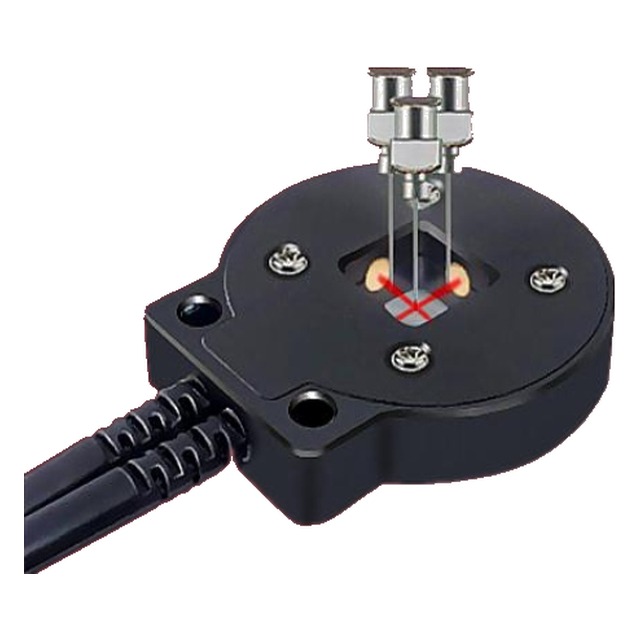
Diffuse unit LEWY-F5.0 at 180 mm, 3.2 ms mode, area detection on. The wide spot covers the bottle neck without a mechanical guide.
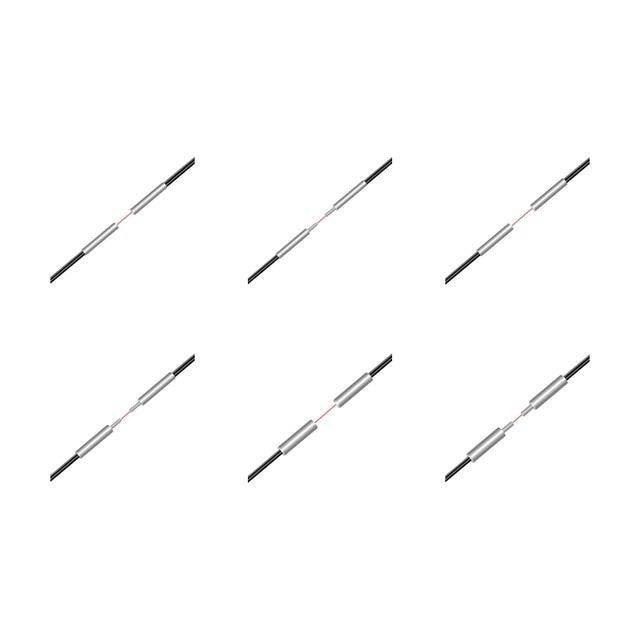
Through-beam pair LEWY-D5 across the flap path, 6.4 ms mode. The slower mode ignores the dust that a corrugator throws up.
Four LG-03IN set to F1–F4 on four Ø1 mm through-beam pairs, no interconnection between units.
| Type | Fiber amplifier, open-collector output, Chinese-language display |
|---|---|
| Light source | Red 4-element LED |
| Response time | F1 16 µs · F2 19 µs · F3 22 µs · F4 25 µs |
| Output mode | LIGHT-ON / DARK-ON, programmable (M.S.R. + four logic functions) |
| Mutual interference | Prevented by the frequency-switching function — up to 4 units in a row |
| Detection mode | Fiber (area detection possible) |
| Delay function | OFF-delay / ON-delay / single-shot / ON-delay single-shot, 1–9999 ms |
| Protection | Reverse polarity, surge, over-current, ESD |
| Control output | NPN / PNP open collector 24 V, 100 mA (main unit only) · 20 mA with expansion unit · residual voltage ≤1 V |
| Timer range | 1–9999 ms |
| Useful functions | Parameter initialisation, key lock, two-point teach, full-auto / manual teach, fast saturation, area setting |
| Supply voltage | 12–24 V DC ±10 %, ripple (P-P) ≤10 % |
| Power consumption | 12–24 V DC ±10 %, ripple (P-P) ≤10 %, Class 2 |
| Ambient temperature | −20 to +55 °C, 35–85 %RH |
| Ambient light | Incandescent 20,000 lux · sunlight 30,000 lux |
| Vibration | 10–55 Hz, 1.5 mm amplitude, 2 h in X, Y, Z |
| Housing material | Polycarbonate |
| Dimensions | 30 mm (H) × 10.8 mm (W) × 80 mm (D) |
| Weight | Approx. 60 g |
| Item | Value |
|---|---|
| Body width | 10.8 mm |
| Body depth | 80 mm (30.6 mm to the display window) |
| Mounting slot | 10 mm from the cable end, M3 |
| Fiber port | Ø4.0 mm bore |
| Cable | 2 m, 3-core |
The body is 1.2 mm narrower and 1.2 mm shorter than the LE series, so a mixed row needs a shim or a separate bracket.
| Core | Colour |
|---|---|
| 2 | Blue |
| 3 | Black |
Where the setting is done by a line operator, the LG's Chinese menu removes the guesswork; where an engineer sets it once from a printout, the LE's two numeric displays are faster to read.
Set F1, F2, F3 and F4 on adjacent amplifiers. There is no white core to chain, so the separation is by modulation frequency.
The LG's fastest response is 1.5 ms — fine for a part above 3 mm at conveyor speed, not for a 0.3 mm wire. That is the boundary between this family and the LE-025N.
300 mW of amplifier power does not change the light budget: the sensing distance comes from the fiber unit, so choose the unit from the distance and the spot size first.
Chinese labels on the display, with the same parameter numbering as the LE series, so a setting sheet written for one family can be followed on the other.
Forty amplifiers in one cabinet draw 12 W instead of 36 W — the difference between a passive backplate and a fan.
Four modulation frequencies separate four adjacent units without any interconnection between them, which keeps a multi-lane row a three-wire job.
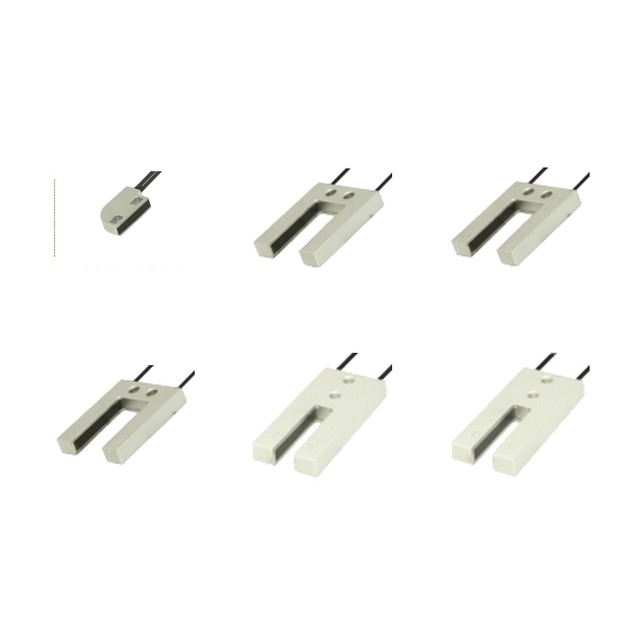
The beam can be evaluated over a region rather than a point, so a label with print on it does not read as a gap and a mesh belt does not read as a part.
Functionally yes for slow applications, but not for fast ones: 1.5 ms against 60 µs. It is also 1.2 mm smaller in two dimensions, so the mounting holes do not line up.
Yes. Both use the same Ø4 mm port and the same lock lever, so any unit in this chapter fits either amplifier.
The receiver picks up the neighbouring emitter's modulated light and the output chatters. Four units, four modes — F1, F2, F3, F4.
Send your application details or the guard opening dimensions and we will specify the right model and configuration for your machine.