AC control circuits
Replaces a 24 V switch plus a relay where the panel is 110 or 230 V AC.

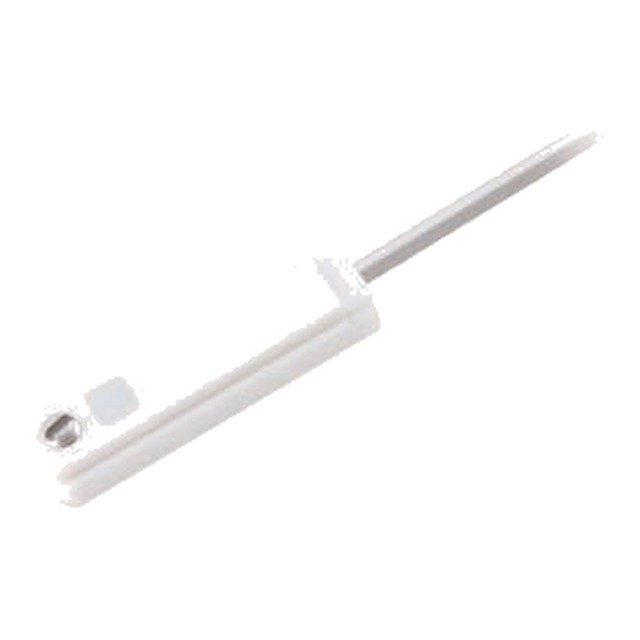
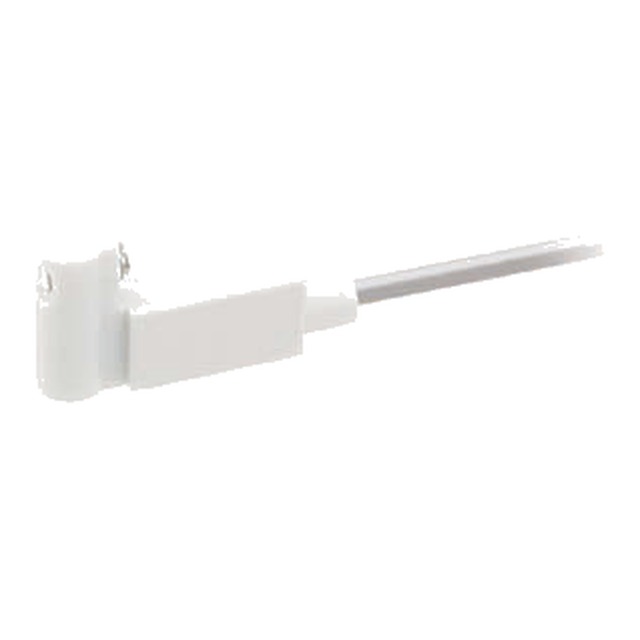
Reed-type magnetic switches for cylinders and actuators: 60–800 Gauss, 10–240 V AC/DC, 100 mA and 10 W, in a body that fits the same grooves as the electroni
Model CMSJ · CMSG · CMSE · CS1-F · CS1-U · 3045 · Brand LE Raun · Category: Magnetic Sensors
A reed switch is two ferromagnetic blades sealed in a glass tube. A magnetic field makes the blades touch; the field goes away and the spring in the blades separates them. The contact itself needs no supply — the circuit it closes provides the signal — which is why a reed switch can sit directly in a 230 V AC control circuit.The C series is that principle in a cylinder-groove body: 60–800 Gauss sensitivity, 10–240 V AC/DC, 100 mA and 10 W maximum, 200 Hz switching frequency, 50 G shock and 9 G vibration, −10 to +70 °C and IP64. There is no protection circuit in the body, so an inductive load needs its own suppression.The trade against the D series is straightforward. The C series takes AC, carries 10 W and needs no supply of its own; the D series switches 1000 Hz, draws 2.5–100 mA from a 10–28 V rail and has no contact to stick. Choose by the circuit that already exists, not by a switching speed the application will never use.
Replaces a 24 V switch plus a relay where the panel is 110 or 230 V AC.
Reports open and closed on a clamp or an ejector.
Two switches set the travel limits on a rotary actuator.
Reports that a gate is shut, for the machine sequence rather than as a certified interlock.
The 10–240 V AC/DC range drops into an existing AC circuit without changing the panel.
| Sensor switch type | Contact type (reed) |
|---|---|
| Sensing sensitivity | 60–800 Gauss |
| Supply voltage | 10–240 V AC/DC |
| Max. switching current | 100 mA |
| Max. contact capacitance | 10 W max. |
| Max. switching frequency | 200 Hz |
| Shock resistance | 50 G |
| Vibration resistance | 9 G |
| Protection circuit | None — an inductive load needs its own suppression |
| Operating temperature | −10 to +70 °C |
| Protection level | IP64 |
| Indicator lamp | Red LED |
| Cable | 2-core or 3-core, oil-resistant grey PVC |
| Product application | Determines quantity and mounting position according to cylinder control requirements |
| Switching voltage | AC/DC 100 V max. (reed), 24 VDC (solid state) |
| Response time | ≤1 ms |
| Item | Value |
|---|---|
| Cable | 2.8 mm, 2- or 3-core, oil-resistant grey PVC |
| Cable length | 1 / 3 / 5 m |
| Sensing distance | 60 – 80 gauss operating point |
Reed switches are sold against a magnet, not against a distance: the 60–80 gauss figure is the field the switch needs, so a smaller magnet has to sit closer.
| Lead | Colour |
|---|---|
| 2 | Blue |
| — | 3-wire types |
Cylinders differ in groove shape: a C-groove, a round groove or a tie-rod. The switch body is shaped for one of them, and no bracket will make a C-groove switch hold in a round groove.
A reed contact is cheap and works on AC or DC, but it bounces and welds under inrush. A solid-state switch has no moving contact — the right choice on a high-cycle line or in a weld field.
2-wire is simplest for a PLC input in series with the load; 3-wire gives a defined output and a shorter response time.
The switch operates over a band along the stroke, not at a point. Where the repeatability matters, order the narrow-band version and set it at mid-stroke.
A 10–240 V AC/DC rating means the switch can sit in an AC control circuit without a relay or a 24 V supply — which is why reed switches are still specified on older machines.
The contact carries 100 mA and switches 10 W, enough to drive a small relay or a lamp directly where an electronic switch would need an interface.
A reed contact is slower than a magnetoresistive one, but a pneumatic cylinder cycling at a few hertz does not need more.
Dust-tight and splash-resistant, with the indicator at the switch so the point can be seen during setup.
Reed if the circuit is AC, if 10 W of load is needed, or if there is no 24 V supply available. Magnetoresistive (D series) if the cycle rate is high, the switch will see millions of operations, or contact bounce would upset the controller.
Yes for a DC relay or solenoid coil. There is no protection circuit inside the C-series body, so an unsuppressed coil will arc the contacts and shorten their life. On AC, use an RC snubber across the coil.
The catalogue lists them as separate part numbers with the same electrical specification — 10–240 V AC/DC, 100 mA, 10 W, 60–800 Gauss — so the difference is the body rather than the contact rating. Confirm the groove width against the cylinder before ordering.
Send your application details or the guard opening dimensions and we will specify the right model and configuration for your machine.