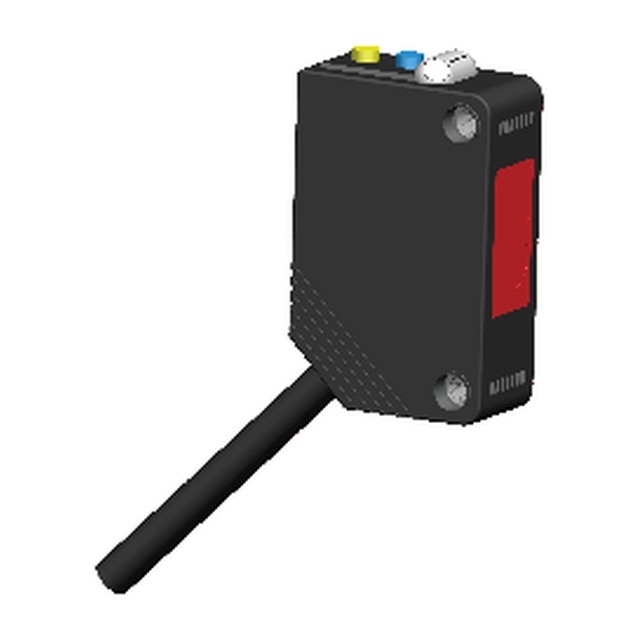
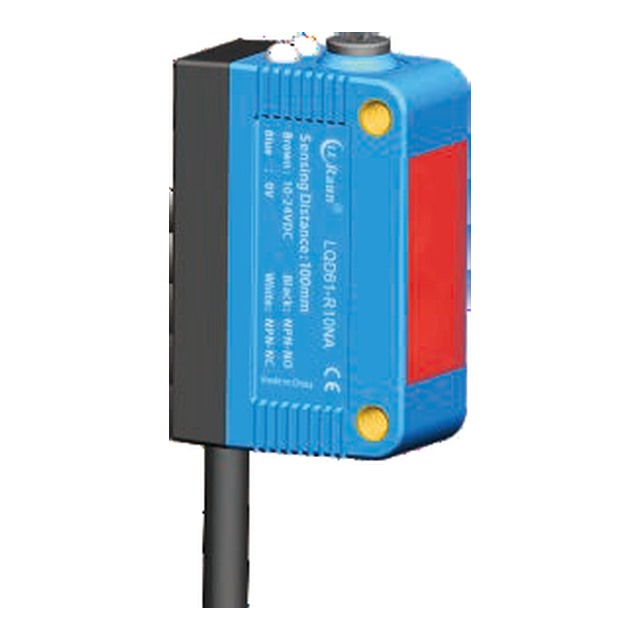
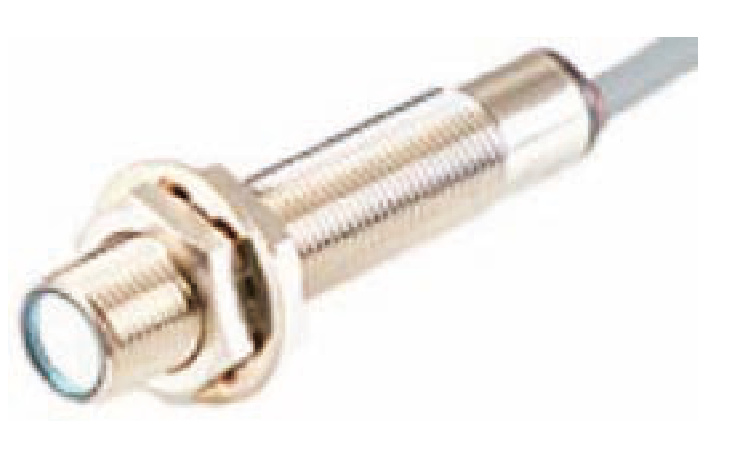
Stacker crane height
Reads the fork height up an AS/RS aisle to 20 m with 4–20 mA output.

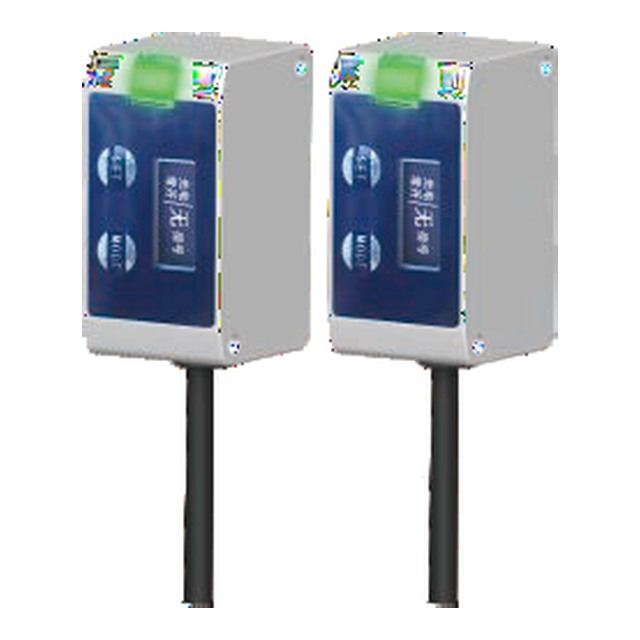
TOF laser sensors from 0.05 m to 20 m with NPN/PNP, 4–20 mA and optional RS485 output — for cranes, stacker cranes, vehicles and large workpieces.
Model LTOF-R500 / R1000 / JG50 / JG100 / JG200 · Brand LE Raun · Category: Laser Sensors
Two families cover the long end of the range. The R series (500 and 1,000) is the accurate one: ±30 mm below 5 m, running to 10.2 m on a white target, with a switchable response time from 1 ms to 1 s so the reading can be averaged on a vibrating structure. The JG series goes to 20 m at ±6 cm — enough for a crane or a stacker crane position, not enough for a measurement.The I/U/R suffix selects the interface: NPN, 4–20 mA or RS485. The analogue output is the useful one for a stacker crane — the PLC reads a continuous height rather than counting pulses — and RS485 allows several sensors on one bus down an aisle.
Reads the fork height up an AS/RS aisle to 20 m with 4–20 mA output.
Measures the distance to the load or the end stop.
Detects a truck or container at a loading bay.
Reads the surface of bulk material through dust.
Detects a steel plate or a weldment before a robot cycle.
| Models | LTOF-R500N(I/U/R) · LTOF-R1000N(I/U/R) · LTOF-JG50-N(I/U/R) · LTOF-JG100-N(I/U/R) · LTOF-JG200-N(I/U/R) |
|---|---|
| Detection method | Diffuse reflection (time-of-flight) |
| Detection distance | 0.05–5.2 m @ 10 % (R500) · 0.05–10.2 m @ 80 % (R1000) · 5 m (JG50) · 10 m (JG100) · 20 m (JG200) |
| Absolute accuracy | ± 30 mm below 5 m, 1 % above 5 m (R series) · ± 6 cm below 6 m, ± 1 % above 6 m (JG series) |
| Repeat accuracy | ± 5 mm (R series) · ± 20 mm below 6 m, ± 0.5 % above 6 m (JG series) |
| Output mode | NPN and PNP · 4–20 mA · RS485 (optional) |
| Response time | ≤ 1 ms / 1.5 ms / 10 ms / 100 ms / 1,000 ms switchable (R series) · 20 ms (JG) |
| Light source | Laser diode, 650 nm, < 1.5 mW |
| Laser class | Class 1 |
| Sensitivity adjustment | One-touch setting type |
| Protection level | IP65 |
| Power consumption | < 0.6 W (R series) · < 0.9 W (JG series) |
| Operating voltage | 9–30 V DC ±10% (R series) · DC 12–24 V ±10% (JG series) |
| Spot size | 0.5 – 2 mm at the working distance, depending on model |
| Circuit protection | Short-circuit, reverse polarity, over-current |
| Item | Value |
|---|---|
| Mounting holes | 2 × Ø3.0 mm |
| Display | OLED, visible from the top face |
| Cable | 2 m |
The long-range LTOF is a metal-bodied unit with an OLED display: the 5 / 10 / 20 m versions share the same 44 × 26.5 × 23 mm envelope, so a bracket designed for one takes the others.
| Lead | Colour |
|---|---|
| 2 | Blue |
| 3 | Black |
| 4 | White |
| — | Grey |
Through-beam for the longest range and the sharpest edge; retro-reflective for one-sided wiring; diffuse with background suppression where the object must be distinguished from the machine frame; time-of-flight where the range exceeds a few metres.
The spot grows with distance: a 1 mm spot at 300 mm may be 5 mm at 2 m. For a thin wire or a small hole, choose a model with a small spot at that specific distance.
A switching output answers 'is it there'; an analogue or RS-485 output answers 'where is it'. Positioning tasks need the analogue or the serial version, not a teach-in threshold.
Shiny, black or transparent targets change the received power; the BGS types are set on distance rather than on intensity, which is why they hold on a black part against a bright background.
Covers an aisle, a crane travel or a silo depth with one sensor.
Continuous distance to the PLC, or several sensors on one bus.
1 ms for a moving target, 1 s averaging for a vibrating structure.
R for accuracy over 5–10 m, JG for 20 m where ±6 cm is acceptable.
The interface: I = 4–20 mA, U = NPN/PNP switching, R = RS485.
It tolerates more dust than a triangulation sensor, but a silo with heavy airborne dust needs a radar or an acoustic sensor.
Send your application details or the guard opening dimensions and we will specify the right model and configuration for your machine.