Packaging film registration
The eye-mark on a printed film is detected before the sealing station so the cut lands on the printed panel instead of across it.

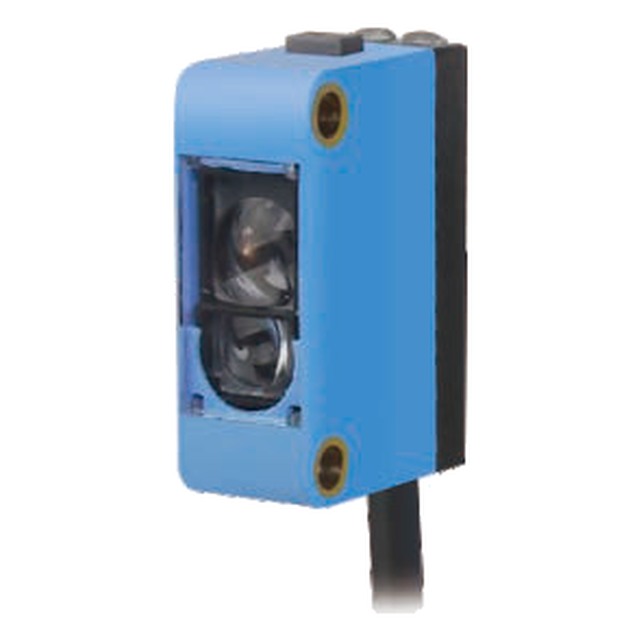
Two registration-mark sensors for packaging and printing: the single-output MARK with a 2 × 5 mm spot at 5–20 mm, and the two-output EM-S11N(P) that switch
Model MARK / EM-S11N(P) · Brand LE Raun · Category: Color Sensors
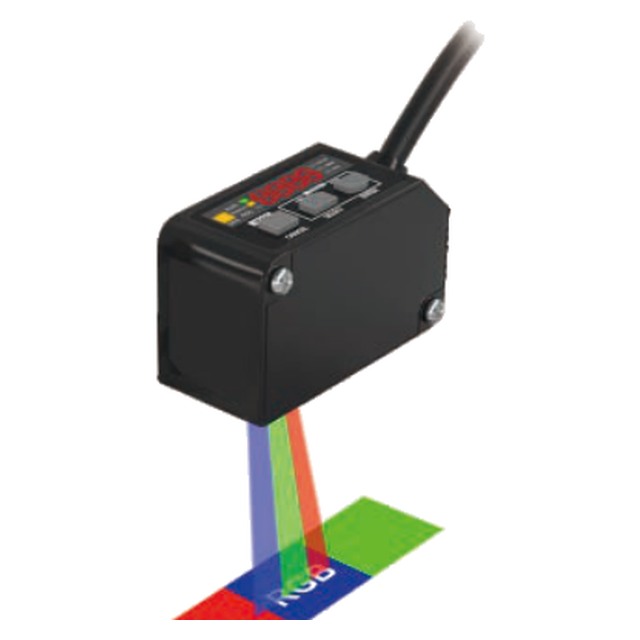
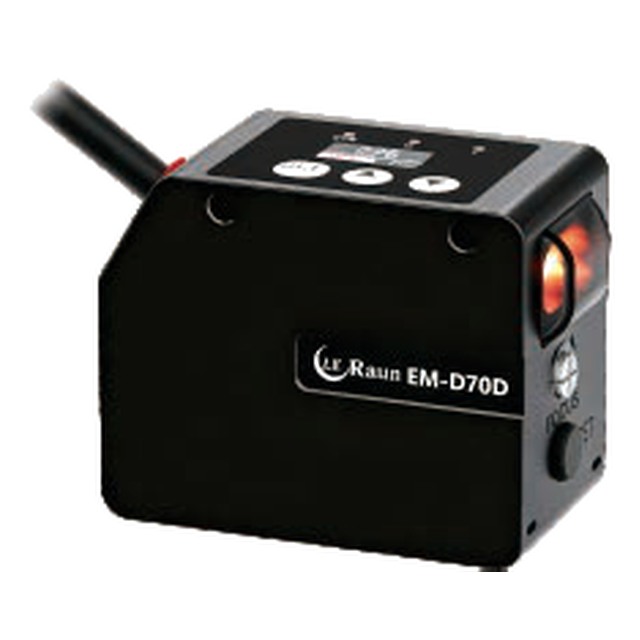
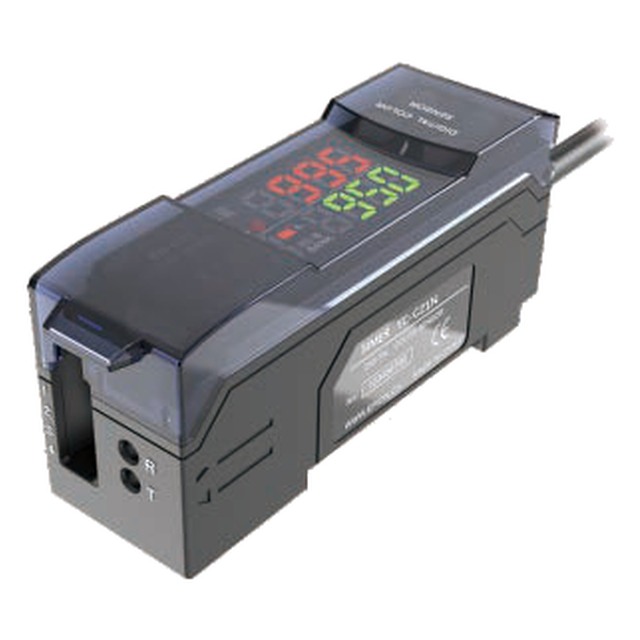
A colour-mark sensor is a photoelectric sensor with a deliberate narrow spectral response. It illuminates a small spot, measures the reflected intensity in one or more wavelength bands, and compares the result with a taught reference. When the mark passes, the ratio changes and the output switches.The MARK is the simple version: one output, a 2 × 5 mm spot at 5–20 mm, and a monochromatic source chosen to maximise contrast against the mark. It is the sensor you fit when the job is “find the black eye-mark on this white film” and nothing else.The EM-S11N adds an RGB full-colour mode. In colour-mark mode it behaves like the MARK; in colour mode it compares the complete returned spectrum, so it can tell a red cap from an orange one instead of just detecting that something is there. Both are cable-out; the MARK runs from 10–24 V DC and the EM-S11N from 24 V DC, and both are rated to +55 °C.
The eye-mark on a printed film is detected before the sealing station so the cut lands on the printed panel instead of across it.
Finds the gap or the mark between labels on a release liner and triggers the applicator.
Compares the position of a printed mark to the encoder position and feeds the correction back to the register control.
Confirms that the cap on a filled bottle matches the product in the line — a colour check, not just a presence check.
Detects the printed metre mark or the colour band on a cable jacket at line speed.
| Series | MARK (compact) · EM-S11N(P) (all-in-one) |
|---|---|
| Output type | 1 output, cable-out type (MARK) · 1 output, cable-out type (EM-S11N) |
| Sensing distance | 5–20 mm (MARK) · 18–30 mm (EM-S11N) |
| Spot size | 2 × 5 mm (MARK) · 1.5 × 7 mm (EM-S11N) |
| Response time | 0.1–1 ms (MARK) · ≤ 0.2 ms (EM-S11N) |
| Control output | NPN or PNP open-collector |
| Light source | Monochromatic light source (MARK) · monochromatic in colour-mark mode / RGB three-colour in colour mode (EM-S11N) |
| Operating voltage | 10–24 V DC ±10 % (MARK) · 24 V DC ±10 % (EM-S11N) |
| Ambient temperature | −10 to +55 °C (MARK) · −15 to +55 °C (EM-S11N), no freezing, no condensation |
| Product application | Detection of marked pattern colour blocks, colour strips, or preprinted registration marks on a web |
| Item | Value |
|---|---|
| Overall length | 57.0 mm including the fibre port and its strain relief |
| Mounting holes | 2 × Ø4.50, 25.0 mm centres, 5.0 mm from the body edges |
| Fibre port | 25.0 mm above the base, on the front face |
The two Ø4.5 holes sit on the centre line of the side face, so the unit can be bolted flat to a plate with the fibre port facing the mark. The 57 mm overall length already includes the port — do not add it twice when you lay out the guard.
| Lead | Colour |
|---|---|
| 2 | Blue |
| 3 | Black |
| 4 | White |
| 5 | Grey |
A mark on a web (colour mark), a printed colour against a reference (ΔE), or a shade that the eye cannot separate. Mark sensors work on contrast and are fast; the digital types work on a colour value and are repeatable.
The spot must be smaller than the mark for a mark sensor, and must sit entirely on the colour to be judged. A 2 mm spot on a 1 mm print register mark reads the paper as much as the ink.
White light separates similar colours; a single-colour LED is more robust on a shiny substrate but blind to metameric pairs. Where the colour difference is small, ask for the RGB-difference version rather than a contrast sensor.
Where one machine runs several products, order the version with four or eight stored references and switch them from the recipe in the PLC.
At 0.1–1 ms the sensor resolves a mark on a web moving faster than the eye can follow — the difference between a registration correction that lands and one that arrives a label late.
The EM-S11N switches between a monochromatic colour-mark mode for a printed eye-mark and a full-colour mode that compares the whole returned spectrum, so the same sensor can verify a cap colour as well as find a mark.
Both models leave the factory with a moulded cable. On a retrofit that is one less part number, one less crimp and one less place for washdown water to enter.
Colour-mark mode looks at one narrow band and switches on a change in intensity — fast and tolerant of a drifting print density. Colour-recognition mode compares the full spectrum and can classify the colour itself, which is what you need to verify a cap or a label rather than to find a mark.
The spot is 2 × 5 mm on the MARK and 1.5 × 7 mm on the EM-S11N, so a mark narrower than the spot will not develop full contrast. Aim for a mark at least as wide as the short dimension of the spot.
Only if the mark is opaque. The sensor measures reflected light, and a clear film reflects almost nothing — the mark is detected, the film around it is not, which is exactly what registration control needs. For a transparent mark on a transparent film, a through-beam or ultrasonic solution is a better fit.
Send your application details or the guard opening dimensions and we will specify the right model and configuration for your machine.