AGV and AMR navigation
Scans the surroundings for localisation against a map and for obstacles in the path.

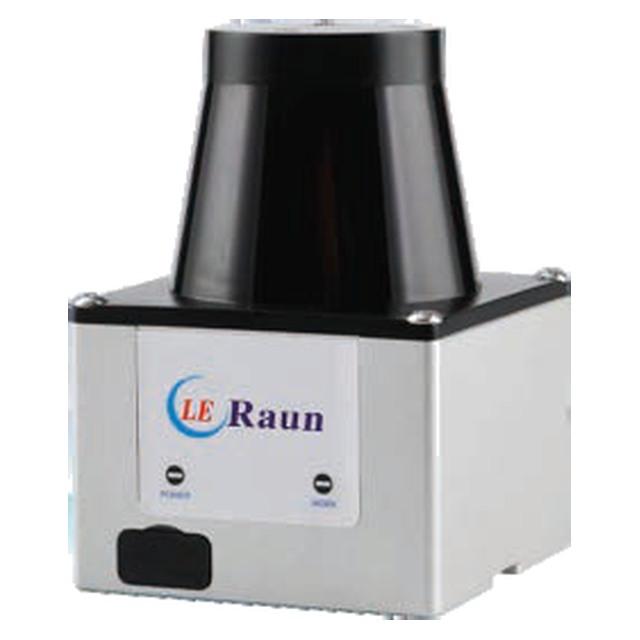
A 270° scanning LiDAR with a 25 m range and 15 Hz scan rate, packaged in a 60 × 60 × 85 mm body for AGVs, mobile robots and fixed-area monitoring.
Model LE-ILS-F31-C · Brand LE Raun · Category: Laser Displacement & Profile
The LE-ILS-F31-C is a 2D scanning LiDAR: a 905 nm infrared beam is swept through 270° by a rotating mirror, and the time of flight of each return gives a polar point. Fifteen complete scans per second, each with a 25 m reach, produce the point cloud that a navigation stack consumes.The numbers that decide the application are the scan rate and the response time, not the maximum range. At 15 Hz a vehicle moving at 1.5 m/s advances 10 cm between scans, and the 60 ms response adds another 9 cm — which is why the stop field is configured with a margin rather than at the geometric braking distance.The body is 60 × 60 × 85 mm, runs from 9–28 V DC and communicates over RS232 or Type-C. IP65 and 80 000 lx ambient-light immunity let it work in a lit warehouse and in a yard, and the class 1 laser classification means no additional guarding is required for the beam itself.
Scans the surroundings for localisation against a map and for obstacles in the path.
Two zones — a warning field and a stop field — are configured from the scan, so the vehicle slows before it stops.
Mounted at a corner, one unit watches a 270° sector of a machine cell or a storage area.
Measures the free gap in an aisle before a forklift or a shuttle enters.
The scan data can be logged for a coarse 2D map of a room, a yard or a conveyor layout.
| Maximum range | 25 m |
|---|---|
| Accuracy | ±3 cm |
| Scanning angle | 270° |
| Scanning frequency | 15 Hz |
| Response time | 60 ms |
| Output mode | RS232 / Type-C |
| Supply voltage | DC 9–28 V |
| Laser type | Infrared 905 nm, safety class 1 — no special protection required |
| Outer dimensions | 60 × 60 × 85 mm |
| Ambient light immunity | 80 000 lx |
| Protection level | IP65 |
| Product application | Object scanning and detection with data transmission; mobile vehicles or fixed positions; compact body for easy installation, maintenance and disassembly |
| Measuring principle | Laser triangulation for short range, time-of-flight for long range |
| Typical repeatability | 1 – 10 µm on the triangulation models |
| Linearity | ±0.1 % F.S. on the precision models |
| Sampling rate | Up to 1 kHz on the fast models |
| Light source | Red 650 nm or blue 405 nm laser, Class 1 / Class 2 |
| Item | Value |
|---|---|
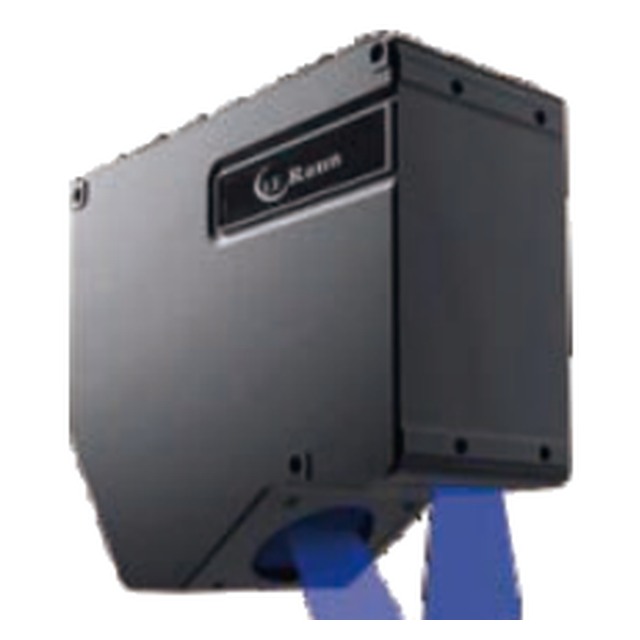
| Scanner | Rotating head on the top face, 270° field |
| Connection | M12 Ethernet and power connectors on the rear face |
The 85 mm is the height of the body alone; the rotating head adds nothing to it, but the 270° sweep means nothing may stand within 60 mm of the front face.
| Connection | Function |
|---|---|
| Blue | 0 V |
| Black | Switching output / alarm |
| White | Analogue output (4–20 mA or 0–10 V) |
| Shield | Earth — bond at the controller end only |
Triangulation covers a few millimetres to about a metre with µm resolution; beyond that the time-of-flight models take over at millimetre resolution. Do not ask a 10 mm-range sensor to measure at 500 mm — the spot has already walked off the receiver.
A shiny machined face sends the beam away from the receiver, a black rubber part absorbs it, and a transparent film lets it through. Blue-laser models are the answer for hot, red-glowing or organic surfaces; a 45° mounting removes most mirror reflections.
Analogue for a fast control loop, RS485 when several sensors share one bus or when the reading has to be logged, switching output for a simple go/no-go.
A 1 µm sensor is only as good as its bracket. Thermal growth of an aluminium bracket over 10 °C is more than the repeatability of the sensor; use cast iron, granite or a short, stiff bracket.
A single scan covers three sides of the vehicle, which is what an AGV needs to see a corner it is turning into without a second sensor.
905 nm at class 1 means the beam is safe under normal use, so the sensor can be exposed on an open vehicle without an interlocked enclosure.
At 15 Hz the scan period is 67 ms and the response time is 60 ms, so the control loop sees a fresh field within one cycle — fast enough to stop a vehicle at walking speed.
It is the maximum. Detection at 25 m depends on the target reflectance — a white wall returns far more light than a black jacket. For safety-related stopping distances, plan on a shorter working range and verify with the actual targets.
No. It is a class 1 laser scanner for navigation and monitoring, not a certified safety laser scanner. Where a person has to be protected, use a type 3 or type 4 safety device with the appropriate performance level.
The sensor streams scan data over RS232 or Type-C. Most integrations read the stream directly into a ROS driver or a small parser; there is no proprietary licence between the sensor and your controller.
Send your application details or the guard opening dimensions and we will specify the right model and configuration for your machine.