Part presence on a dark conveyor
Detects a light part while ignoring the black belt behind it.

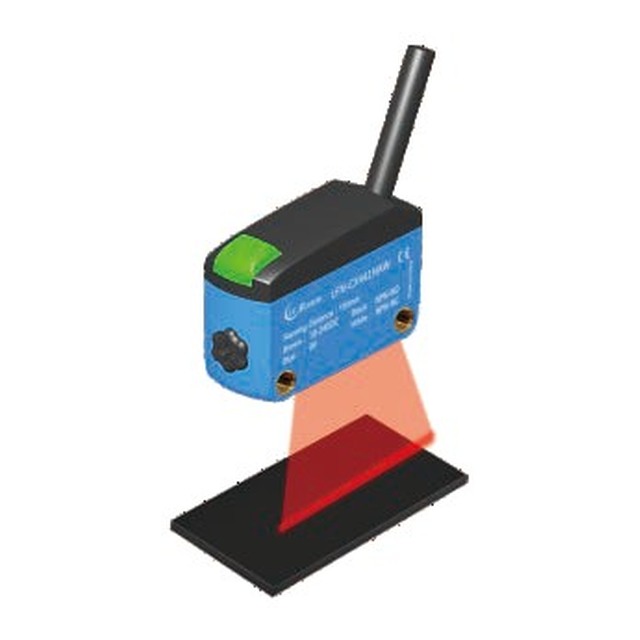
A background-suppression sensor with three spot geometries — small, large and strip (bar-shaped) — so a 100/200/300 mm window can be set to ignore whatever s
Model LFN-CX441 / 442 / 443 · Brand LE Raun · Category: Photoelectric Sensors
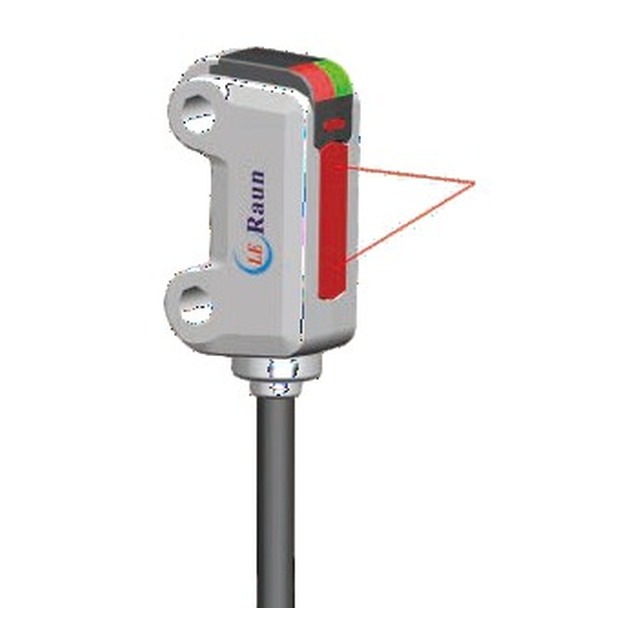
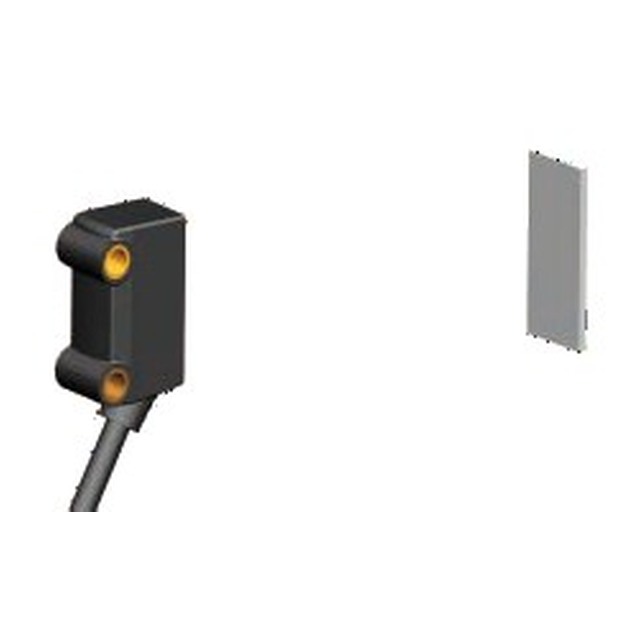
Background suppression is what makes a diffuse sensor usable on a real machine. Instead of measuring how much light comes back, the LFN-CX44 measures where it comes back from: the receiver is split into two elements, and the sensor switches only when the target is inside the set window and the background is beyond it. A black conveyor behind a white part, or a shiny machine frame behind a matte carton, no longer causes false triggers.Three spot shapes cover the usual cases. The small spot is for fine positioning of small parts; the large spot gives a broader detection area for irregular objects; the strip (bar-shaped) spot is for edge detection and for detecting objects that arrive at any orientation — a horizontal or vertical bar reads a wire or a thread regardless of how it is rotated.
Detects a light part while ignoring the black belt behind it.
The strip spot reads the edge of a web or the gap between two panels.
Ignores the steel frame behind the conveyor.
Detects transparent or reflective flat parts at a fixed distance.
Confirms a part is in the gripper against a cluttered background.
| Models | LFN-CX441N(P)DW / CX442N(P)DW / CX443N(P)DW (small spot) · LFN-CX441N(P)W / CX442N(P)W / CX443N(P)W (large spot) · LFN-CX441N(P)AW / CX442N(P)AW (strip light spot) |
|---|---|
| Detection method | Diffuse-reflective type (background suppression) |
| Detection range | 100 mm adjustable (CX441) · 200 mm adjustable (CX442) · 300 mm adjustable (CX443) · 100 mm adjustable (AW) |
| Sensitivity adjustment | Multi-turn potentiometer |
| Output mode | NPN or PNP open collector |
| Switch mode | L.on / D.on switchable |
| Response time | ≤ 2 ms |
| Light source | Infrared LED (650 nm) |
| Operating voltage | 12–24 VDC ±10% |
| Protection level | IP65 |
| Cable exit type | 2 m 4-core cable |
| Product application | Presence/absence detection for glass, PCB and other objects; suitable for complex application scenarios |
| Current consumption | ≤15 mA |
| Output current | ≤100 mA |
| Residual voltage | ≤1.5 V |
| Circuit protection | Short-circuit, reverse polarity, over-current |
| Ambient illumination | Incandescent ≤3,000 lux, sunlight ≤10,000 lux |
| Vibration / shock | 10–55 Hz 1.5 mm, 500 m/s² (X, Y, Z each 2 h) |
| Item | Value |
|---|---|
| Mounting holes | Ø3 mm, 26.5 mm pitch |
| Cable | 2 m, 4-core |
The 12 mm depth is what lets the CX44 sit between two plates of a fixture; the 26.5 mm hole pitch is the same as the LFD square body, so the two are interchangeable on a bracket.
| Lead | Colour |
|---|---|
| 2 | Blue |
| 3 | Black |
| 4 | White |
| — | Grey (5-wire types) |
Through-beam for the longest range and the most reliable operation in dust; retro-reflective for one-sided wiring over a few metres; diffuse for colour-independent presence at short range; background suppression where the conveyor or the machine frame sits behind the target.
A diffuse sensor sees the target, not the gap: a dark matt object halves the range. Background suppression types are set by distance, so the background must be at least 20 % further away than the target.
A 10 mm spot on a 2 mm wire gives a weak, unstable signal; choose a lens with a small spot at the working distance, or switch to a laser type.
NPN for Asian PLC inputs, PNP for European; 4-wire when the PLC needs both states. Square plastic for general use, stainless for washdown, fibre-optic where the space is too tight.
The window is set by distance, not by reflectivity, so dark or shiny backgrounds do not cause false switching.
Small, large and bar-shaped spots for fine parts, irregular parts and edges.
Fine adjustment of the 100/200/300 mm cut-off without a teach button.
The spot geometry: DW is the small spot, W the large spot, AW the bar-shaped strip spot. Ranges and electronics are the same.
It detects transparent objects by the light they return; for clear film on a clear liner use the capacitive label sensor instead.
Background suppression needs a triangulation baseline; longer ranges need a time-of-flight or laser sensor.
Send your application details or the guard opening dimensions and we will specify the right model and configuration for your machine.