Robot gripper finger
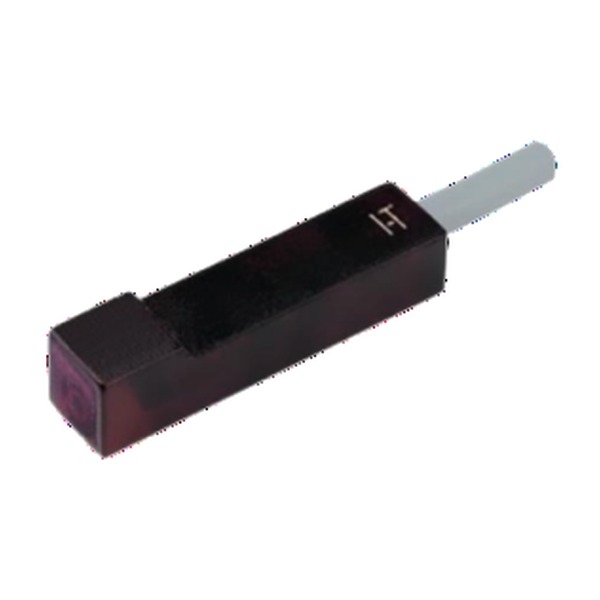
A 5 mm slab bolts to the finger and detects the part the moment it is gripped, with the cable running back along the finger.

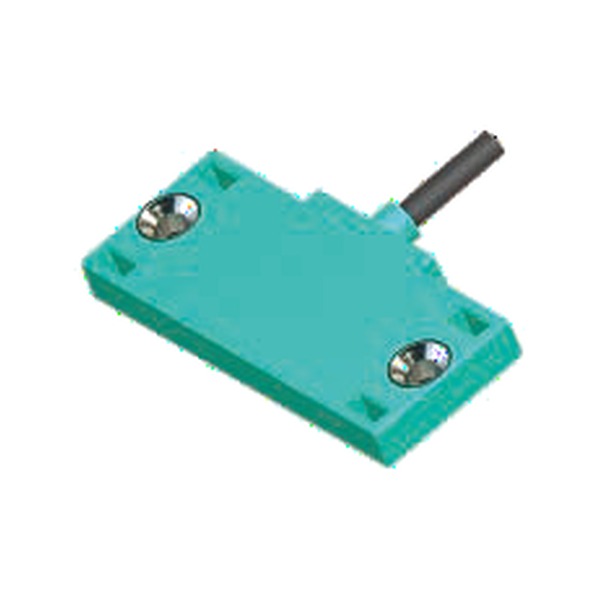
A 5 mm thick slab with the sensing face on the flat: bolts to a gripper finger, a conveyor edge or the inside of a channel where no barrel fits.
Model LEF05 / LEF10 / LEH05 / LEH10 / LEC10 · Brand LE Raun · Category: Proximity Sensors
A flat inductive sensor is a coil wound on a flat former inside a thin plastic slab. It gives up range — 5 or 10 mm from a 50 mm face, against 15 mm from an M30 — but it gives back a mounting surface: the whole back of the slab can be bolted flat, and the face can look sideways out of a 5 mm gap.Three shapes cover the usual cases. The LEF is 50.3 × 22 × 5 mm with the face on the flat side, flush-mountable. The LEH is 42 × 25 × 6 mm, non-flush, with a wider field. The LEC is 10 mm thick with an adjustable 2 – 10 mm range for when the gap varies.All are 10 – 30 V DC, 100 Hz, 1.5 ms response, IP67, with NPN or PNP output.
A 5 mm slab bolts to the finger and detects the part the moment it is gripped, with the cable running back along the finger.
Mounted flat in the side rail, it detects parts sliding past without standing in the product path.
The LEF10 with a 10 mm range sits under the table surface and detects the sheet through a 2 mm aluminium plate.
The flat body slides between two magazine walls and sees the tote arriving.
A 5 mm sensor on the flap hinge reads the closed position where a barrel would foul the frame.
| Series | LEF05 · LEF10 · LEH05 · LEH10 · LEC10 |
|---|---|
| Dimensions | 50.3 × 22 × 5 mm (LEF) · 42 × 25 × 6 mm (LEH) · 50 × 25 × 10 mm (LEC) |
| Sensing distance | 5 mm or 10 mm fixed (LEF / LEH) · 2 – 10 mm adjustable (LEC) |
| Mounting | Flush (LEF, LEC) · non-flush (LEH) |
| Housing / face | PBT body and face |
| Operating voltage | 10 – 30 V DC |
| Switching frequency | 100 Hz |
| Response time | 1.5 ms |
| Repeat accuracy | < 5 % |
| Ambient temperature | −25 °C – +70 °C |
| Output | NPN / PNP, NO / NC — NO / NC and PO / PC suffix |
| Protection | IP67 |
| Current consumption | ≤10 mA |
| Output current | ≤200 mA |
| Voltage drop | ≤1.5 V |
| Hysteresis | ≤0.05 mm of the sensing distance |
| Circuit protection | Short-circuit, overload, reverse polarity |
| Cable | 2 m PVC, 3 × 0.2 mm², oil-resistant |
| Item | Value |
|---|---|
| Mounting holes | 2 × Ø3.2 mm, 42 mm apart |
| Sensing face | 25 × 10 mm, on the 50 mm face |
| Cable | 2 m PVC, 3-core |
10 mm thick, so it slides behind a conveyor belt or under a transfer plate where no barrel would fit.
| Lead | Colour |
|---|---|
| 2 | Blue |
| 3 | Black |
| — | Two-wire types |
A shielded (flush) sensor can be embedded in metal with only its face exposed, at about 60 % of the unshielded range. An unshielded sensor needs a free zone around the barrel but reaches further.
Order at least 1.5 × the nominal distance to allow for tolerances, temperature and target material. Non-ferrous targets — brass, aluminium, copper, stainless — reduce the distance to roughly 30–50 %.
The target should be at least as large as the sensing face. A smaller target reduces the distance proportionally, so a 4 mm target on an M18 sensor will not switch at 5 mm.
NPN / PNP, NO / NC, 3-wire or 2-wire. Plastic barrel for general use, stainless for weld fields, PTFE-faced for weld spatter, high-temperature types up to 120 °C.
The sensing face is the flat side, so the sensor can be bolted flat to a surface and still see sideways — no bracket and no stand-off.
The LEF has the face on one flat side; the LEH is non-flush with a wider field; the LEC is 10 mm thick with an adjustable 2 – 10 mm range.
A flat 50 mm field is effectively a presence strip: anything crossing the face trips it, regardless of where it crosses.
Through-holes at each end let it sit flat on a gripper finger or a channel wall without a right-angle bracket.
No — through a non-metal cover, yes; through metal, no. For a sheet on a metal table you need a cut-out or the LEC mounted above the surface.
About 10 – 20 % per millimetre of plastic. Tell us the cover material and thickness and we will confirm the gap.
A gripper at 100 cycles/minute is fine. Above that, use the square LJQ family at 1 kHz.
 Ultra-Short Inductive Proximity Sensors (15 – 28 mm body)Proximity Sensors
 Ultra-Compact Inductive Proximity Sensors (φ3 to M6)Proximity Sensors
 Standard Inductive Proximity Sensors, Short Barrel (M6.5 – M30)Proximity Sensors
 Square-Type Inductive Proximity Sensors (5 × 5 to 17 × 17 mm)Proximity Sensors
Send your application details or the guard opening dimensions and we will specify the right model and configuration for your machine.