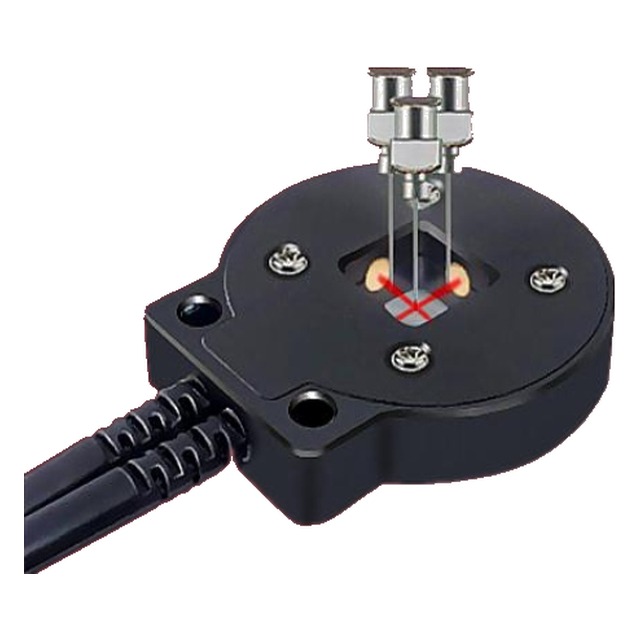
0.4 mm connector contact
LETE-M310 across a 20 mm track, LE-025N at 16 µs. The Ø0.25 mm core is the reason the contact is visible at all.

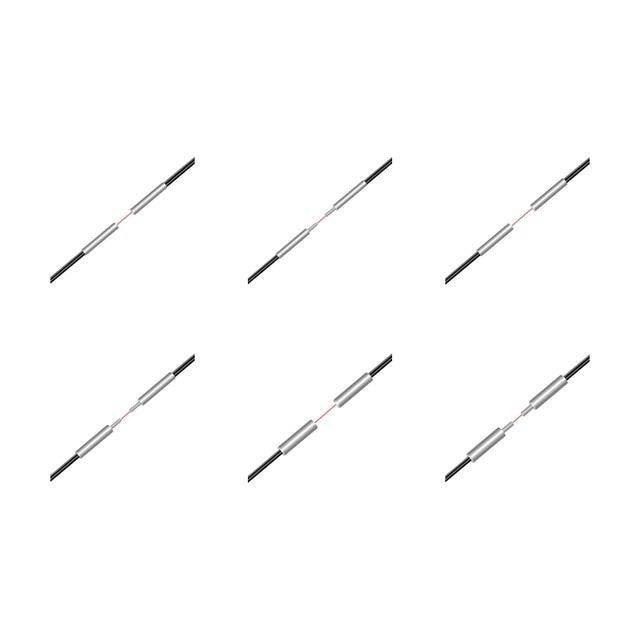
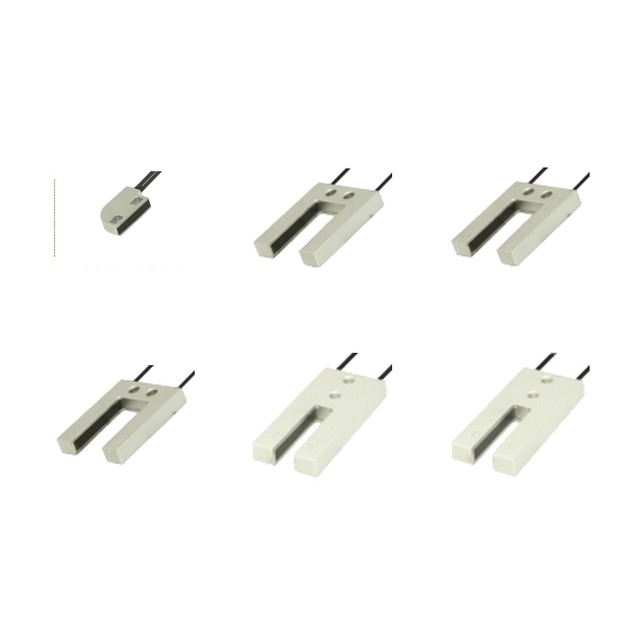
Twelve emitter-receiver pairs from a 1 mm whisker to a 1 m gap: the smallest core is Ø0.25 mm for a wire or a 0.4 mm contact, the largest reaches 1 m between
Model LEWY-D2 · LEWY-D3 · LEWY-D5 · LETE-M310 · LETS-M310 · LETA-M310 · Brand LE Raun · Category: Fiber Optic Sensors
A through-beam pair is the most reliable optical detection there is: the receiver sees a shadow rather than a reflection, so surface finish, colour and angle stop mattering. The cost is mechanical — two fibers, two mounting points, one axis that has to be aligned.The table is arranged by core size. Ø0.25 mm cores (LETE-M310, LEWY-D3) resolve the smallest features and reach 60 mm. Ø0.5 mm cores (LETS, LEWY-D2, LEWY-D3S10) are the general-purpose pair at 200–260 mm. Ø1.0 mm cores (LETA, LEWY-D5, LETA-M310TZ) reach 400–1000 mm and are the ones to use across a conveyor.The right-angle and coaxial heads exist for the cases where the mounting face is not square to the beam. LETC-M310TZ is the extreme: sixteen emitting cores around the receiver in one Ø2.2 mm jacket, so the pair can look through a single hole in a fixture block.
LETE-M310 across a 20 mm track, LE-025N at 16 µs. The Ø0.25 mm core is the reason the contact is visible at all.
LEWY-D3S10 across a 60 mm gap, 250 µs mode. The R5 bend radius lets the fiber follow the machine arm.
LETA-M310 with a 1000 mm gap between two M3 heads — no bridge, no reflector, no alignment drift from the conveyor frame.
LETC-M310TZ in one M3 hole, 600 mm, coaxial. The part passes through the block; nothing can be mounted on the far side.
| Type | Through-beam fiber unit — separate emitter and receiver fibers, one amplifier |
|---|---|
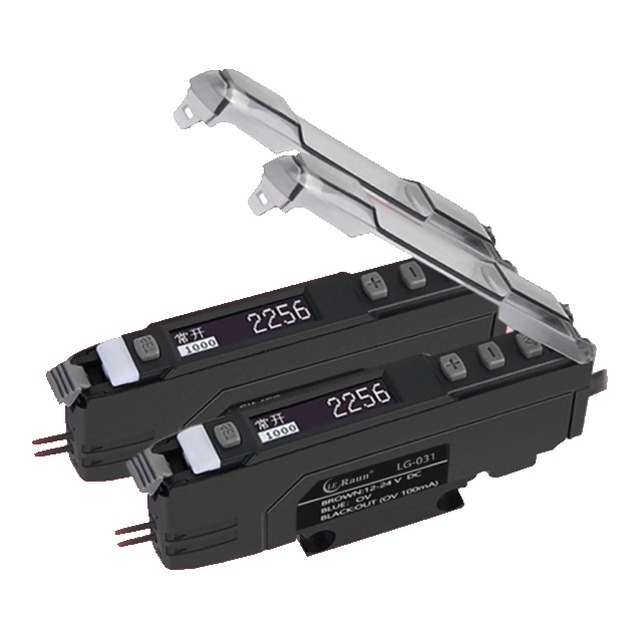
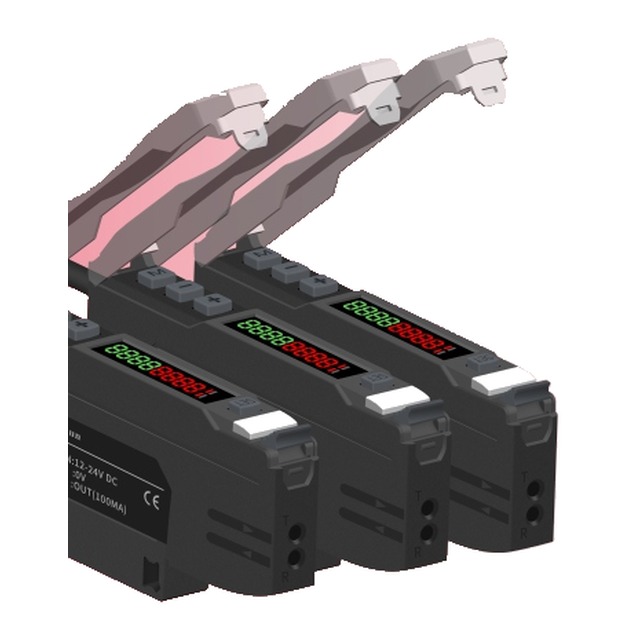
| Amplifier | One amplifier per pair (emitter and receiver plug into the same body) |
| Fiber length | 1 m standard; 1000 / 2000 mm to order |
| Sensing distance | 60 mm (LEWY-D3) to 1000 mm (LETA-M310) |
| Minimum target | 0.1 mm with the Ø0.25 mm core types, 0.5 mm with the Ø1.0 mm types |
| Thread | M3P0.25 (LETE) · M3P0.5 (LETS / LETA / LETC) · none on the LEWY plain types |
| Bend radius | R5 to R25 depending on the jacket |
| Ambient temperature | −50 to +70 °C at the fiber |
| Repeatability | Set by the amplifier; the pair itself adds no hysteresis |
| Item | Value |
|---|---|
| Jacket diameter at the amplifier end | Ø2.2 mm, two fork terminals |
| Tip extension | Ø0.5 / Ø0.9 / Ø1.5 mm × 10 / 20 / 40 / 90 mm (replaceable tip) |
| Thread length | 13 mm (M3 types) |
| Right-angle head | 7 mm across flats, 5.8 mm to the fiber axis |
| Mounting | Two M3 nuts, 5.8 mm and 12.7 mm from the tip on the right-angle types |
The sensing distance of a pair is the clear gap between the two tips, not the distance to a target — a through-beam pair works at the same gap whatever the target colour.
| Core | Colour |
|---|---|
| 2 | Blue |
| 3 | Black |
| 4 | White |
A 0.2 mm wire is invisible to a Ø1.0 mm core: the light it blocks is 4 % of the beam. Take the Ø0.25 mm core (LETE / LEWY-D3) and accept the shorter distance.
The core size and the gap trade against each other: Ø0.5 mm cores reach 260 mm, Ø1.0 mm cores 400–1000 mm. If the gap is 500 mm and the part is 0.3 mm, an amplifier with a fast mode and a narrow aperture is a better answer than a bigger fiber.
Threaded M3 for anything that will be adjusted or replaced; plain tips for a hole in a plate.
The TZ heads turn the beam in 5.8 mm, which is often the only way to fit a pair inside a fixture.
A Ø0.25 mm core across a 60 mm gap resolves a 0.1 mm wire with a standard red LED amplifier — no laser class, no alignment jig, no eye-safety paperwork.
A through-beam pair switches on the shadow, not on the reflection, so a black part on a black conveyor is the same as a white part on white.
Ø1.0 mm cores in a Ø2.0 mm jacket reach 1000 mm between two M3 heads — enough to span a conveyor without a mechanical bridge.
LETC-M310TZ puts 16 × Ø0.25 mm emitting cores around the receiver, so a single tapped hole can both send and receive — the only option where the part passes a drilled block.
No — one amplifier drives the emitter fiber and reads the receiver fiber. Both fibers plug into the same body; the amplifier's output switches when the beam is broken.
Core size. A Ø0.25 mm core pair is rated 60 mm; at 200 mm the light reaching the receiver is below the amplifier's floor. Move up to a Ø0.5 mm core pair for 200–260 mm.
A standard red-LED pair will not see clear film. That needs a dedicated transparent-detection amplifier or a polarising arrangement — ask us before specifying.
Send your application details or the guard opening dimensions and we will specify the right model and configuration for your machine.