Bottle and container presence on a filling line
M18 non-flush at 15 mm detects a PET bottle without touching it, from behind the guide rail.

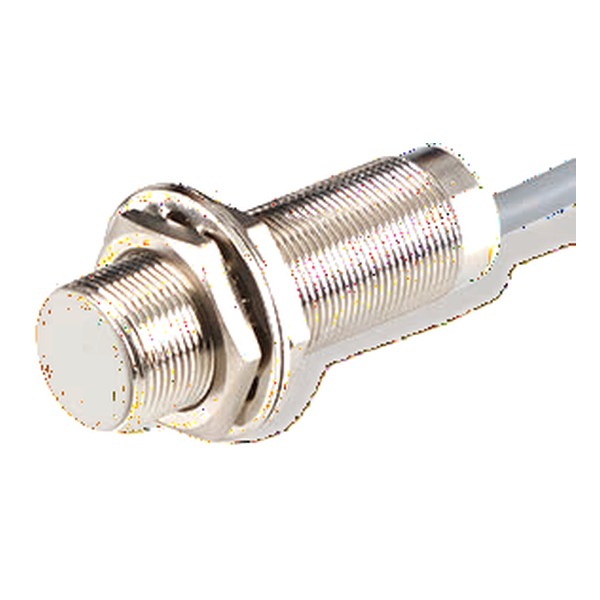
Detects what an inductive sensor cannot: plastic, glass, wood, grain, water and powder, up to 30 mm from an M30 body.
Model LJ8M-E1N / LJ8C-E2N / LJ12M-E3N / LJ12C-E6N / LJ18M-S8N / LJ18C-S15N / LJ30M-S20N / LJ30C-S30N · Brand LE Raun · Category: Proximity Sensors
A capacitive sensor is an inductive sensor with a bigger, unshielded electrode: it responds to any material with a dielectric constant above air, which covers plastic, glass, wood, grain, water and most powders. That makes it the fallback whenever a photoelectric sensor cannot see the target (transparent, matte, dusty) and an inductive sensor cannot either (non-metal).The cost is stability. Humidity, a film of product on the face and the dielectric constant of the material all shift the trip point, which is why every version above M8 has an adjustable setting distance — set it deliberately low and the drift stays inside the margin.Bodies run M8 to M30, sensing 1 mm to 30 mm, at 50 – 100 Hz with a 1.5 ms response. All are 10 – 30 V DC with NPN or PNP, NO or NC output.
M18 non-flush at 15 mm detects a PET bottle without touching it, from behind the guide rail.
M30 body through a plastic hopper wall reports high level; the 20 mm range means it never contacts the product.
M30 flush body through a 3 mm tank wall detects the liquid level without a float switch.
M30 at 30 mm sees a 20 mm board arriving, in a dusty environment where a photoelectric sensor would not last.
M18 non-flush at 15 mm detects the glass edge where an inductive sensor is blind.
| Series | LJ8M-E1N · LJ8C-E2N · LJ12M-E3N · LJ12C-E6N · LJ18M-S8N · LJ18C-S15N · LJ30M-S20N · LJ30C-S30N |
|---|---|
| Body sizes | M8×45 · M12×60 / 65 · M18×70 / 78 · M30×86 / 87 mm |
| Sensing distance | 1 – 30 mm, adjustable on all but the M8 versions |
| Housing / face | Stainless steel (M8), nickel-plated copper (M12 – M30); PBT face |
| Operating voltage | 10 – 30 V DC |
| Switching frequency | 100 Hz (M8) · 50 Hz (M12 – M30) |
| Response time | 1.5 ms |
| Repeat accuracy | < 5.0 % (Sr) |
| Ambient temperature | −25 °C – +70 °C |
| Output | NPN / PNP, NO / NC — N, N2, P, P2 suffix |
| Protection | IP67 |
| Current consumption | ≤10 mA |
| Output current | ≤200 mA |
| Voltage drop | ≤1.5 V |
| Hysteresis | ≤0.05 mm of the sensing distance |
| Circuit protection | Short-circuit, overload, reverse polarity |
| Cable | 2 m PVC, 3 × 0.2 mm², oil-resistant |
| Item | Value |
|---|---|
| Thread | M12 × 1 · M18 × 1 · M30 × 1.5 |
| Cable | Ø4 mm on M12 · Ø5 mm on M18 and M30 |
| Adjustment | Potentiometer under the rear cap on the shielded types |
A capacitive body needs a clear zone in front equal to the sensing distance: mounting it through a metal plate without that clearance makes it switch on the plate.
| Lead | Colour |
|---|---|
| 2 | Blue |
| 3 | Black |
| — | Two-wire types |
A shielded (flush) sensor can be embedded in metal with only its face exposed, at about 60 % of the unshielded range. An unshielded sensor needs a free zone around the barrel but reaches further.
Order at least 1.5 × the nominal distance to allow for tolerances, temperature and target material. Non-ferrous targets — brass, aluminium, copper, stainless — reduce the distance to roughly 30–50 %.
The target should be at least as large as the sensing face. A smaller target reduces the distance proportionally, so a 4 mm target on an M18 sensor will not switch at 5 mm.
NPN / PNP, NO / NC, 3-wire or 2-wire. Plastic barrel for general use, stainless for weld fields, PTFE-faced for weld spatter, high-temperature types up to 120 °C.
Plastic bottles, glass, timber, grain, coolant and powder all change the field. That is the whole reason this family exists.
The pot lets you set the trip point so a 0.5 mm film on a conveyor does not trigger it but the 20 mm block behind it does.
The C bodies are non-flush and reach further; the M bodies sit level in a metal fixture.
50 – 100 Hz is enough for a level or a part on a conveyor, and the lower frequency is what keeps the field stable.
Yes, up to the wall thickness the range allows. A 3 mm HDPE wall with an M30 at 20 mm works; a 10 mm wall does not. Tell us the wall material and thickness and we will confirm.
Product build-up on the face. Capacitive sensors sense through a film, so a crust looks like a target — clean the face or fit the flush version so it wipes itself.
No. It detects both. If you need to separate them, use an inductive sensor for the metal and a capacitive one for the rest.
 Ultra-Thin Flat Inductive Proximity Sensors (5 – 10 mm thick)Proximity Sensors
 Ultra-Short Inductive Proximity Sensors (15 – 28 mm body)Proximity Sensors
 Ultra-Compact Inductive Proximity Sensors (φ3 to M6)Proximity Sensors
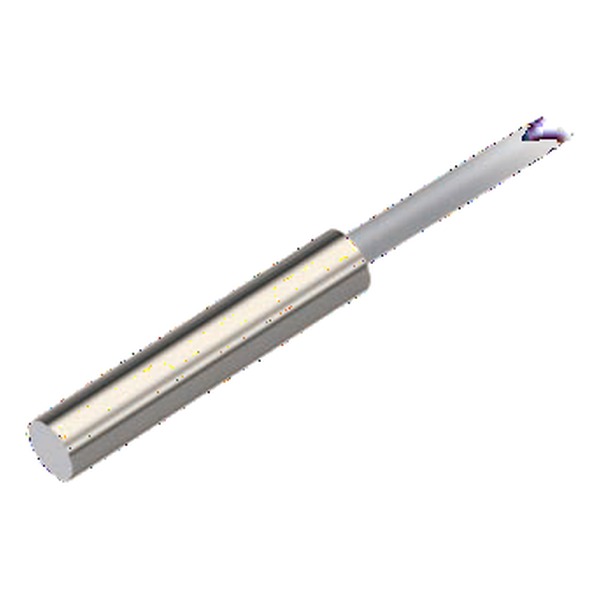 Standard Inductive Proximity Sensors, Short Barrel (M6.5 – M30)Proximity Sensors
Send your application details or the guard opening dimensions and we will specify the right model and configuration for your machine.