Roller conveyor zone control
Twenty 2-wire M18 sensors in series down a conveyor feed a single card, with the leakage current kept under the input threshold.

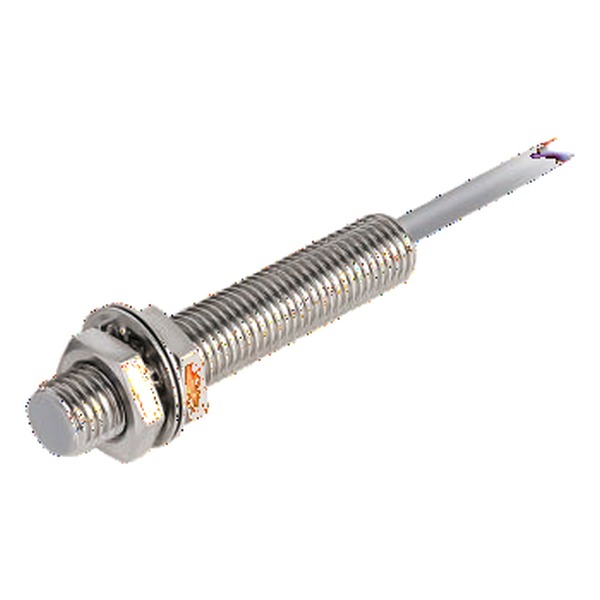
Two wires in series with the load — no separate supply wire, and any number of them can be connected in series into one PLC input.
Model LJ8M-E1B / LJ8C-E2B / LJ12M-E2B / LJ12C-E4B / LJ18M-E5B / LJ18C-E8B / LJ30M-E10B / LJ30C-E15B · Brand LE Raun · Category: Proximity Sensors
A 2-wire sensor sits in series with its load. That means no third wire back to the supply, and — more usefully — that several sensors can be connected in series to one input, which is how conveyor zone chains and multi-point door circuits are usually built.The trade-off is leakage current: a 2-wire sensor draws a small current when it is off, and a very low-impedance input can read that as ON. The sensors here are specified to stay under a standard PLC digital input threshold, but check the input on older cards.Bodies and sensing distances mirror the 3-wire range: 1 – 3 mm on M8, 2 – 8 mm on M12, 5 – 16 mm on M18, 10 – 25 mm on M30, flush and non-flush. The B suffix is normally closed, B2 normally open.
Twenty 2-wire M18 sensors in series down a conveyor feed a single card, with the leakage current kept under the input threshold.
Two-wire M12 bodies confirm open and closed on a hydraulic valve bank wired back to a remote I/O box.
M30 2-wire bodies replace mechanical limit switches without adding a wire to the door harness.
An M18 body counts a bolt head on the shaft; 2-wire keeps the junction box at two terminals.
Replacing a mechanical switch on a 24 V circuit, the 2-wire sensor drops into the same two terminals.
| Series | LJ8M-E1B · LJ8C-E2B · LJ12M-E2B · LJ12C-E4B · LJ18M-E5B · LJ18C-E8B · LJ30M-E10B · LJ30C-E15B |
|---|---|
| Body sizes | M8×45 · M12×35 / 45 / 55 · M18×55 · M30×55 / 58 / 60 mm |
| Sensing distance | 1 – 25 mm (M8: 1–3 · M12: 2–8 · M18: 5–16 · M30: 10–25) |
| Wiring | 2-wire, in series with the load — B = normally closed, B2 = normally open |
| Housing / face | Nickel-plated copper barrel, PBT sensing face |
| Operating voltage | 10 – 30 V DC |
| Switching frequency | 1.2 kHz (M8) down to 100 Hz (25 mm) |
| Repeat accuracy | < 3.0 % (Sr), < 5.0 % (Sr) on the longest ranges |
| Leakage current | Low enough for a standard PLC digital input — check the input threshold |
| Protection | IP67 |
| Current consumption | ≤10 mA |
| Output current | ≤200 mA |
| Voltage drop | ≤1.5 V |
| Hysteresis | ≤0.05 mm of the sensing distance |
| Circuit protection | Short-circuit, overload, reverse polarity |
| Cable | 2 m PVC, 3 × 0.2 mm², oil-resistant |
| Item | Value |
|---|---|
| Thread | M18 × 1 · M30 × 1.5 |
| Cable | Ø5 mm, 2-core |
| Mounting | Two nuts on the thread; non-flush versions leave 5 / 12 / 15 mm free |
Two-wire versions drop straight into an existing mechanical limit-switch circuit — no separate 0 V return, but the residual leakage (0.8 mA) has to be below the input card's OFF threshold.
| Lead | Colour |
|---|---|
| 2 | Blue |
| 3 | Black |
| — | Two-wire types |
A shielded (flush) sensor can be embedded in metal with only its face exposed, at about 60 % of the unshielded range. An unshielded sensor needs a free zone around the barrel but reaches further.
Order at least 1.5 × the nominal distance to allow for tolerances, temperature and target material. Non-ferrous targets — brass, aluminium, copper, stainless — reduce the distance to roughly 30–50 %.
The target should be at least as large as the sensing face. A smaller target reduces the distance proportionally, so a 4 mm target on an M18 sensor will not switch at 5 mm.
NPN / PNP, NO / NC, 3-wire or 2-wire. Plastic barrel for general use, stainless for weld fields, PTFE-faced for weld spatter, high-temperature types up to 120 °C.
Ten 2-wire sensors in series still present a valid signal to one input, which is how a long line of roller zones is normally wired.
No separate 0 V return to the sensor: the load current flows through the sensor, which halves the wiring in a panel.
M8 to M30, flush and non-flush, so brackets and drawings carry over from a 3-wire design.
A 2-wire sensor leaks a small current when off. With a low-impedance input that can read as ON — check the PLC threshold before you standardise.
B is 2-wire normally closed, B2 is 2-wire normally open. Both are 2-wire; the suffix only changes the output state at rest.
Electrically, as many as the total voltage drop allows — each sensor drops about 2 – 3 V. Practically, keep it under ten and check the load still sees enough voltage.
Yes, provided the coil current is above the sensor's minimum operating current. Below that the sensor will not switch cleanly — use the 3-wire version.
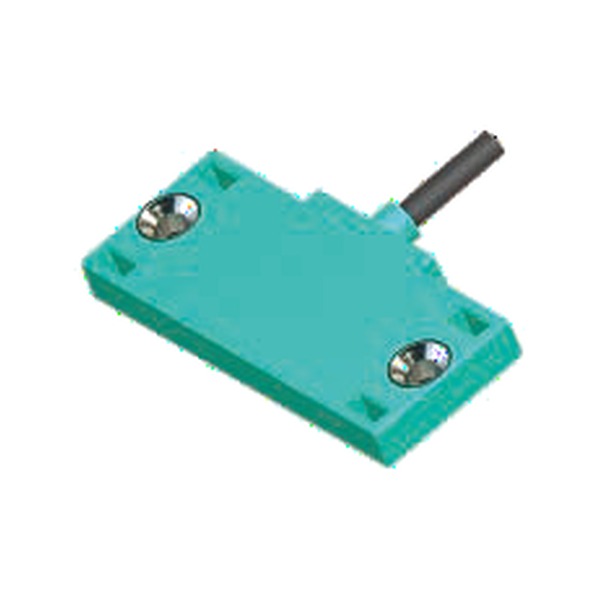 Ultra-Thin Flat Inductive Proximity Sensors (5 – 10 mm thick)Proximity Sensors
 Ultra-Short Inductive Proximity Sensors (15 – 28 mm body)Proximity Sensors
 Ultra-Compact Inductive Proximity Sensors (φ3 to M6)Proximity Sensors
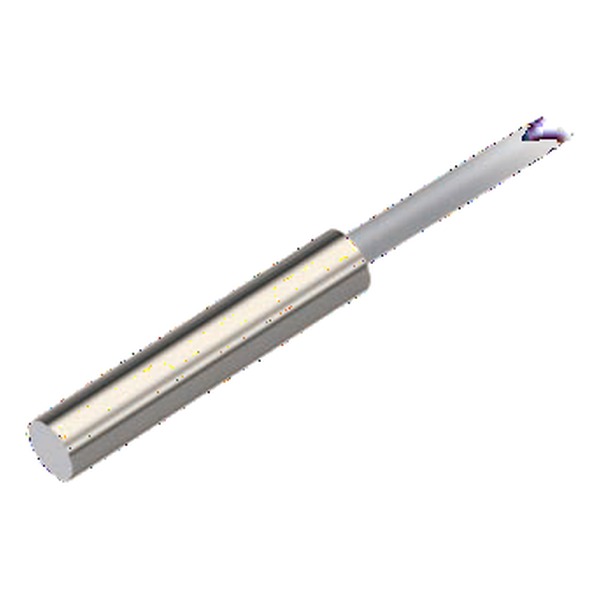 Standard Inductive Proximity Sensors, Short Barrel (M6.5 – M30)Proximity Sensors
Send your application details or the guard opening dimensions and we will specify the right model and configuration for your machine.