Vehicle and axle detection at a weighbridge
M30 bodies at 40 mm read a passing wheel from outside the wheel path, so nothing gets hit.

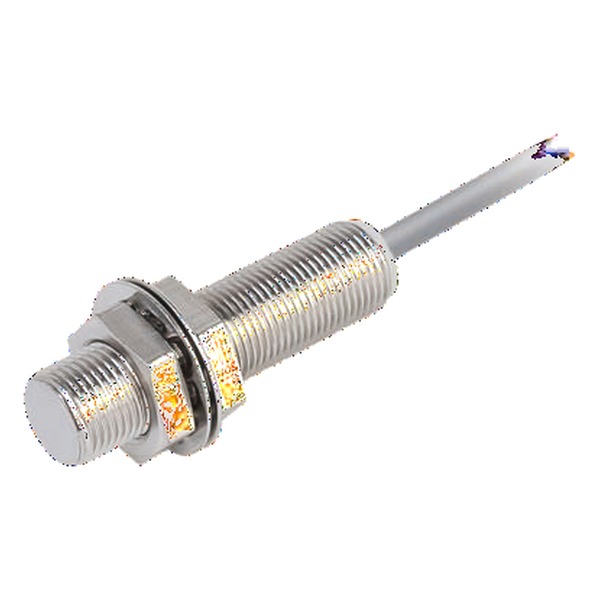
Two to four times the sensing distance of a standard body in the same diameter: 40 mm from an M30, 20 mm from an M18, 10 mm from an M12.
Model LJ6.5M-C / LJ6.5C-C / LJ8M-C / LJ8C-C / LJ12M-C / LJ12C-C / LJ18M-C / LJ18C-C / LJ30M-C / LJ30C-C · Brand LE Raun · Category: Proximity Sensors
The C-series long-range bodies use a larger coil and a higher-gain circuit to reach two to four times the distance of a standard sensor in the same housing. Two things follow: the field is wider, so brackets and adjacent metal matter more, and the switching frequency is lower — 100 Hz at 40 mm against 2 kHz at 2 mm.Both flush (M) and non-flush (C) versions exist at every diameter. Non-flush always reaches further — 40 mm on M30 against 22 mm flush — at the cost of a clearance ring around the face.The J bodies are the same sensors in a longer barrel: M12 to 68 / 72 mm, M18 to 80 / 83 mm, M30 to 80 / 82 mm. Use them where the mounting plate is thick and the face has to reach the far side.
M30 bodies at 40 mm read a passing wheel from outside the wheel path, so nothing gets hit.
Long-range M18 sensors detect the strip without a dancer arm, clear of the oil mist and the strip whip.
A 25 mm range on an M30 sees the load through a 10 mm stainless window in the chute wall.
The sensor sits behind the die shoe and still sees the stock, so it survives a misfeed that would destroy a short-range body.
M30 flush at 15 – 22 mm reads a bolt head on the pulley through a 12 mm gap and a layer of dust.
| Series | LJ6.5M-C · LJ6.5C-C · LJ8M-C · LJ8C-C · LJ12M-C · LJ12C-C · LJ18M-C · LJ18C-C · LJ30M-C · LJ30C-C |
|---|---|
| Sensing distance | 2 – 40 mm (M8: 2–6 · M12: 4–10 · M18: 8–20 · M30: 15–40) |
| Body sizes | φ6.5×45 · M8×45 · M12×45 / 50 · M18×55 / 60 · M30×55 / 60 mm |
| J versions | Longer barrel for deep mounting: M12×68 / 72 · M18×80 / 83 · M30×80 / 82 mm |
| Housing / face | Stainless steel (φ6.5), nickel-plated copper (M8 – M30), PBT face |
| Operating voltage | 10 – 30 V DC |
| Switching frequency | 2 kHz (short ranges) down to 100 Hz (40 mm) |
| Repeat accuracy | < 3.0 % (Sr), < 5.0 % (Sr) on the longest ranges |
| Output | NPN / PNP, NO / NC — N, N2, P, P2 suffix |
| Protection | IP67 |
| Current consumption | ≤10 mA |
| Output current | ≤200 mA |
| Voltage drop | ≤1.5 V |
| Hysteresis | ≤0.05 mm of the sensing distance |
| Circuit protection | Short-circuit, overload, reverse polarity |
| Cable | 2 m PVC, 3 × 0.2 mm², oil-resistant |
| Item | Value |
|---|---|
| Thread | M12 × 1 · M18 × 1 |
| Cable | Ø4 mm on M12 · Ø5 mm on M18 |
| Mounting | Two nuts on the thread; the non-flush versions need the 8 / 12 mm free zone shown on the drawing |
| Lead | Colour |
|---|---|
| 2 | Blue |
| 3 | Black |
| — | Two-wire types |
A shielded (flush) sensor can be embedded in metal with only its face exposed, at about 60 % of the unshielded range. An unshielded sensor needs a free zone around the barrel but reaches further.
Order at least 1.5 × the nominal distance to allow for tolerances, temperature and target material. Non-ferrous targets — brass, aluminium, copper, stainless — reduce the distance to roughly 30–50 %.
The target should be at least as large as the sensing face. A smaller target reduces the distance proportionally, so a 4 mm target on an M18 sensor will not switch at 5 mm.
NPN / PNP, NO / NC, 3-wire or 2-wire. Plastic barrel for general use, stainless for weld fields, PTFE-faced for weld spatter, high-temperature types up to 120 °C.
An M30 at 40 mm and an M18 at 20 mm let the sensor sit behind a guard, a wear plate or a conveyor frame instead of inside the product path.
The M-suffix bodies are flush-mountable and still reach 22 mm on M30 — no clearance ring needed in a tight fixture.
The J versions extend the barrel to 82 mm so the sensing face reaches the bottom of a bore while the cable stays outside the housing.
A 40 mm field will also see the fixture. Mount with the target centred and keep other metal one face diameter away from the sides.
Longer range means a bigger coil and a slower oscillator. If the target moves faster than 100 Hz, use a shorter range and a smaller gap instead.
Yes, but keep at least one face diameter between them, or alternate the mounting so their fields do not overlap. Mutual interference shows up as a chattering output.
A 1 mm stainless window costs roughly 30 – 40 % of the range. Confirm the window thickness with us before you design the pocket.
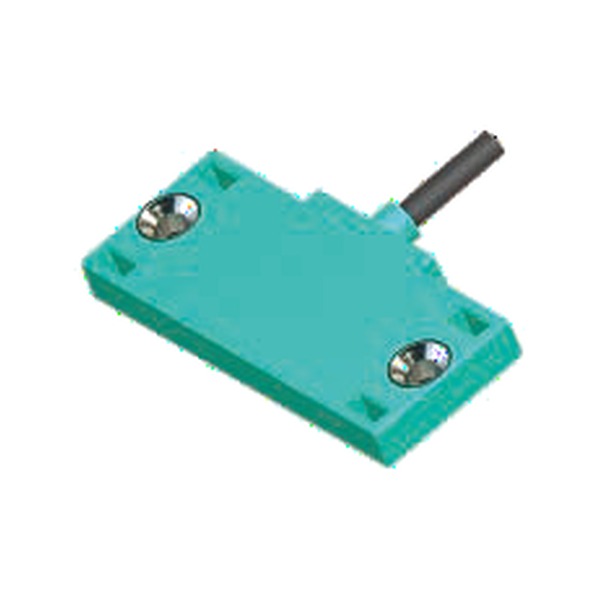 Ultra-Thin Flat Inductive Proximity Sensors (5 – 10 mm thick)Proximity Sensors
 Ultra-Short Inductive Proximity Sensors (15 – 28 mm body)Proximity Sensors
 Ultra-Compact Inductive Proximity Sensors (φ3 to M6)Proximity Sensors
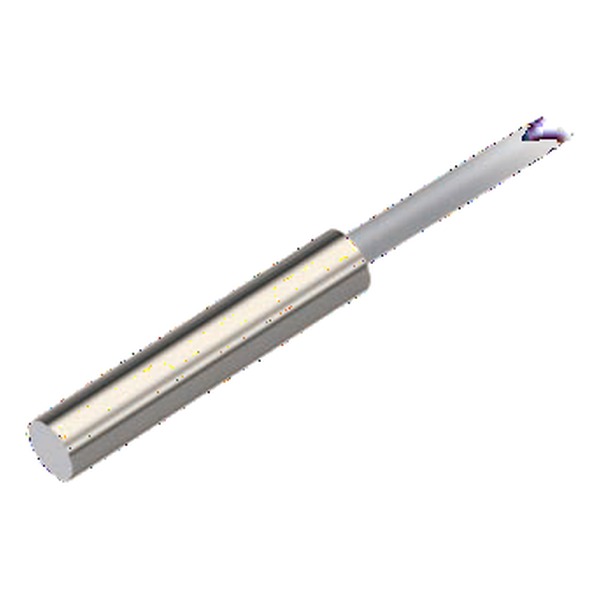 Standard Inductive Proximity Sensors, Short Barrel (M6.5 – M30)Proximity Sensors
Send your application details or the guard opening dimensions and we will specify the right model and configuration for your machine.