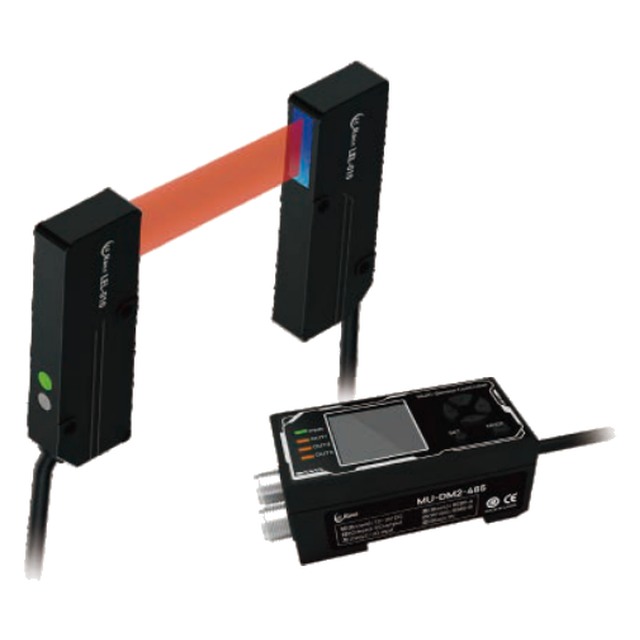
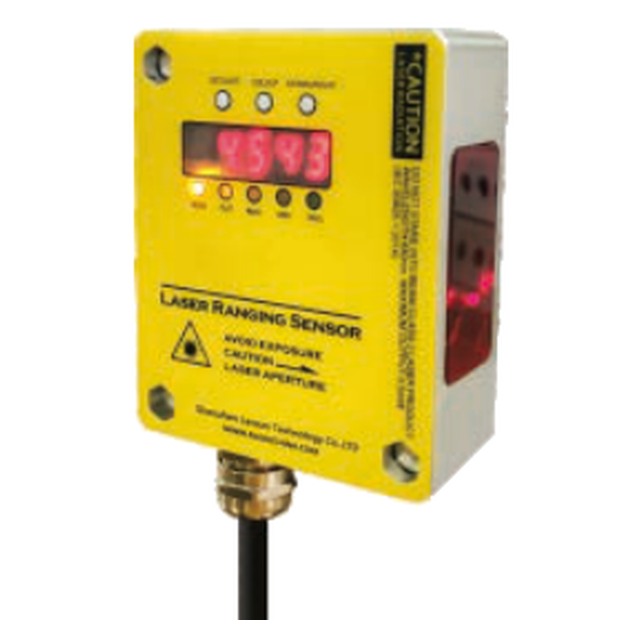
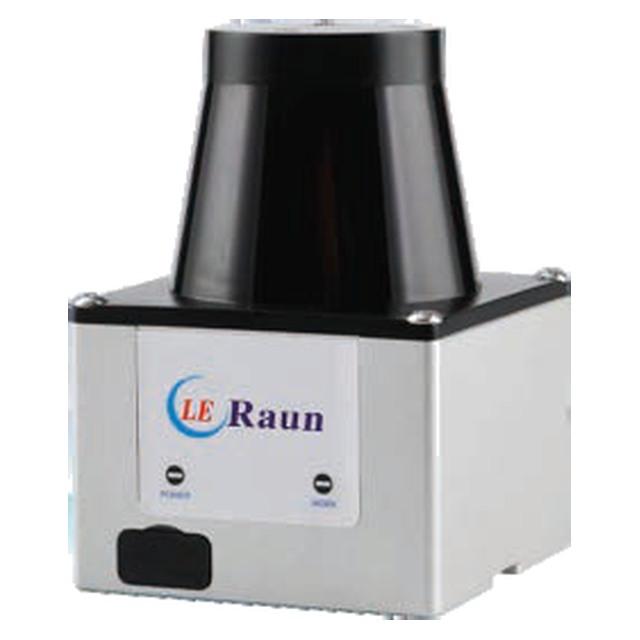
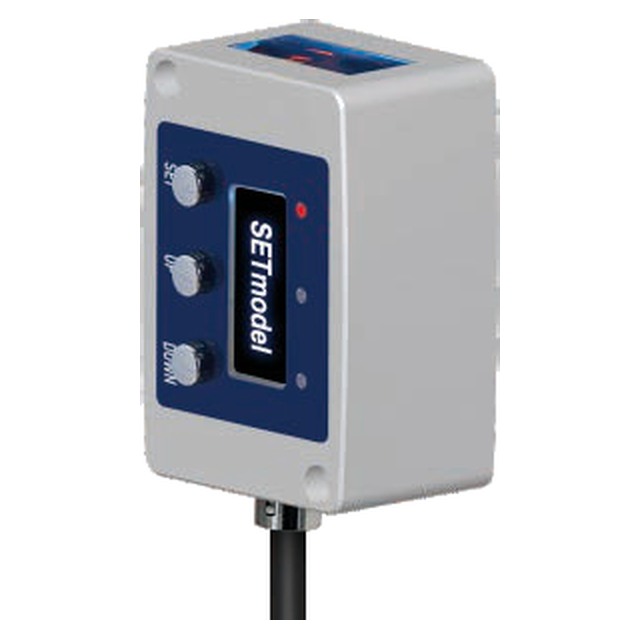
Differential thickness measurement
Two heads on opposite sides of a strip, synchronised by the same controller, subtract the two profiles to give thickness independent of strip float.

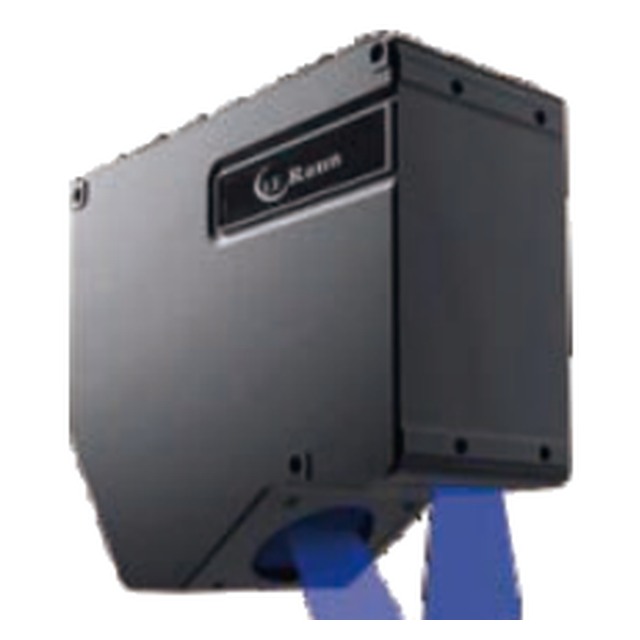
Eleven profile heads and a separate controller: 4096 points per profile, 49 kHz sampling, encoder input and trigger synchronisation for multi-head installati
Model LE-8020 … LE-8900 / LE-81200 + LE-8000 Controller · Brand LE Raun · Category: Laser Displacement & Profile
The LE-8000 series is the controller-based branch of the family. The head contains the laser, the camera and the front-end electronics; the LE-8000 controller contains the trigger logic, the encoder interface and the synchronisation bus. Splitting them is what makes multi-head work practical.That matters most for differential measurement. Two heads facing each other across a strip give two independent profiles; if both are clocked by the same encoder and the same trigger, subtracting them removes the strip float and leaves the thickness. Without the shared controller, the two readings drift against each other and the subtraction is noise.The eleven heads cover 20 mm to 1144 mm with 4096 points and 49 kHz sampling throughout, and the D suffix adds a stereo channel for features that a single view cannot see. The controller runs from 24 V DC at 1.3 A maximum and mounts on DIN rail or horizontally, with a 620 g body and a 0–45 °C rating.
Two heads on opposite sides of a strip, synchronised by the same controller, subtract the two profiles to give thickness independent of strip float.
Robot-mounted heads measure the gap between a door and a fender and the flush of one panel to the next.
Tab height, cell top flatness and module edge straightness on a moving line.
The 300–600 mm heads scan a rail cross-section and compare it to the new profile.
Several heads on one controller cover a wide belt with no blind spots between them.
| Reference distance | 20 mm (LE-8020) · 38 mm (LE-8040) · 62 mm (LE-8060 / 8060D / 8062) · 80 mm (LE-8080) · 160 mm (LE-8160 / 8160D) · 300 mm (LE-8300) · 370 mm (LE-8400) · 600 mm (LE-8600) · 928 mm (LE-8900) · 1144 mm (LE-81200) |
|---|---|
| Repeat accuracy | Z ±0.3 µm / X ±0.3 µm (LE-8020) · Z ±0.4 µm / X ±0.5 µm (LE-8040) · Z ±0.4 µm / X ±0.8 µm (LE-8060) · Z ±0.5 µm / X ±1 µm (LE-8080) · Z ±1 µm / X ±3 µm (LE-8160) · Z ±3 µm / X ±5 µm (LE-8300) · Z ±5 µm / X ±10 µm (LE-8400, LE-8600) · Z ±15 µm / X ±20 µm (LE-8900) · Z ±25 µm / X ±50 µm (LE-81200) |
| Profile data quantity | 4096 points |
| Sampling speed | 49 kHz |
| HDR | Native single-frame HDR; multi-frame HDR synthesis supported |
| Temperature characteristics | 0.008 % F.S./°C (0.006 % F.S./°C on LE-81200) |
| Laser class | Class 2M laser product, performance mode Class 3B laser product |
| Light source | Blue LD / Red LD |
| Capture mode | 2D + 3D (LE-8060D and LE-8160D add a stereo channel) |
| Protection level | IP67 (IEC60529) |
| Controller model | LE-8000 |
| Controller inputs | Sensor head input · control input (measurement start, stop, trigger) · control output (trigger ready, system error) · sync in/out for multi-head synchronisation · encoder input (single-ended and differential, 5 V / 24 V) |
| Controller supply | 24 V DC ±10 %, max 1.3 A |
| Controller ambient | 0–45 °C (DIN-rail mounting) · 0–40 °C (horizontal mounting) · 35–85 % RH |
| Controller weight | Approx. 620 g |
| Measuring principle | Laser triangulation for short range, time-of-flight for long range |
| Linearity | ±0.1 % F.S. on the precision models |
| Sampling rate | Up to 1 kHz on the fast models |
| Interface | Analogue 4–20 mA / 0–10 V, RS485, or digital switching outputs |
| Supply | 12–24 VDC or 24 VDC depending on series |
| Item | Value |
|---|---|
| LE-8600 | 150.0 × 90.0 × 35.5 mm, working distance 600 mm, field of view 400 – 931 mm |
| LE-8900 | 130.0 × 125.0 × 35.5 mm, working distance 535 mm, field of view 620 mm |
| LE-81200 | 120.0 × 110.0 × 35.5 mm, working distance 1144 mm, field of view 2000 mm |
| Mounting | 4 × M4, 5 mm deep, on the back; 4 × M4 on the base |
The field of view is quoted at the working distance, and it is a trapezoid, not a rectangle — the near edge is the narrow number. Lay the conveyor out from the narrow edge or the scan will clip the part.
| Connection | Function |
|---|---|
| Blue | 0 V |
| Black | Switching output / alarm |
| White | Analogue output (4–20 mA or 0–10 V) |
| Shield | Earth — bond at the controller end only |
Triangulation covers a few millimetres to about a metre with µm resolution; beyond that the time-of-flight models take over at millimetre resolution. Do not ask a 10 mm-range sensor to measure at 500 mm — the spot has already walked off the receiver.
A shiny machined face sends the beam away from the receiver, a black rubber part absorbs it, and a transparent film lets it through. Blue-laser models are the answer for hot, red-glowing or organic surfaces; a 45° mounting removes most mirror reflections.
Analogue for a fast control loop, RS485 when several sensors share one bus or when the reading has to be logged, switching output for a simple go/no-go.
A 1 µm sensor is only as good as its bracket. Thermal growth of an aluminium bracket over 10 °C is more than the repeatability of the sensor; use cast iron, granite or a short, stiff bracket.
Encoder input, trigger in/out and an 8-pin sync bus mean the controller, not the PC, keeps two heads on the same encoder clock — which is what a differential measurement needs.
The 8060D and 8160D add a second camera, so a deep slot or a vertical wall that a single view cannot see is covered by the second angle.
From 20 mm to 1144 mm the head plugs into the same LE-8000. Adding a station to an existing machine is a bracket and a cable, not a new architecture.
One controller per head; a single controller can synchronise several heads through the sync in/out pair, which is how differential and multi-head setups are built. If you only need one head and a simple stream to a PC, an LE-6000 or LE-7000 head without a separate controller is the cheaper route.
A second view of the same laser line from a different angle. On a deep slot the single camera sees one wall and shadows the other; the stereo pair sees both, so the profile closes across the bottom of the feature.
The LE-8040 or LE-8062 at 38–62 mm on a robot wrist. The gap is a few millimetres wide and the flush tolerance is a few tenths, which is inside their repeat accuracy; longer-range heads would be mounted too far from the surface to resolve it.
Send your application details or the guard opening dimensions and we will specify the right model and configuration for your machine.