Packaging at a distance
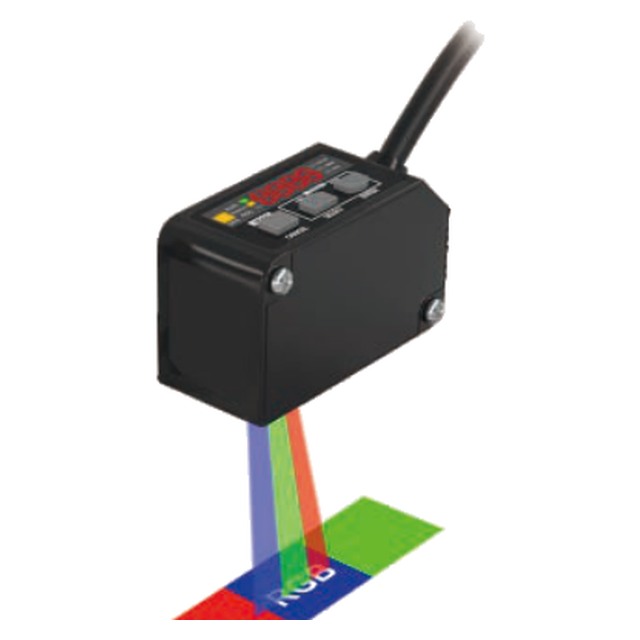
The sensor is mounted above a conveyor, clear of the film path, and reads the registration mark as the pack passes.

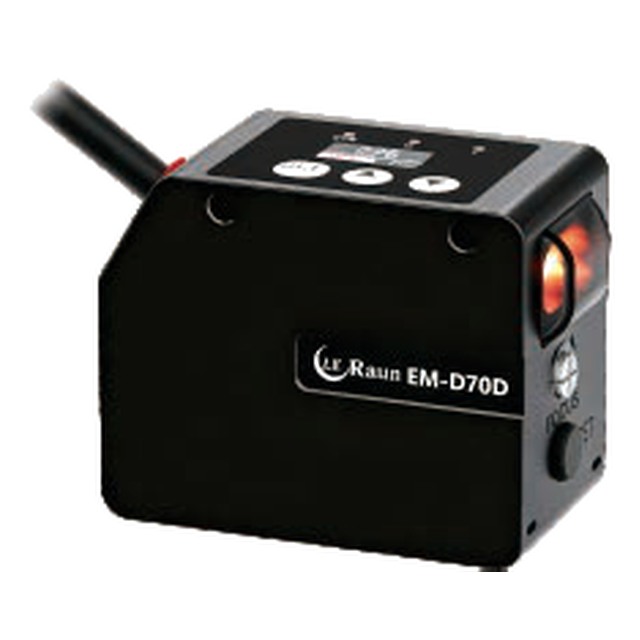
A white-LED colour sensor that covers 30 mm to 1500 mm on the web, in single-spot and dual-spot versions, with a 200 µs response and an optional RS-485 output.
Model EM-D70DS / D70D / D150D / D500D (-485) · Brand LE Raun · Category: Color Sensors
Long-range colour sensing is a compromise: as the stand-off grows, the spot grows with it and the returned light falls off. The EM-D70 handles that with a white LED and an auto-scaled spot — ≈7 mm at 50 mm stand-off on the EM-D70, ≈20 mm at 500 mm on the EM-D500.The dual-spot variants are the practical answer to substrate drift. A single-spot sensor compares the mark with a taught value; if the paper batch changes colour, the taught value is wrong. A dual-spot sensor compares the mark with the surrounding material in the same reading, so the substrate cancels out.Everything is in a zinc-alloy die-cast housing with a 2 m PVC cable, rated for 12–24 V DC at ≤50 mA (24 V) or ≤110 mA (12 V), excluding the load. The -485 versions put the measurement on a bus, which is useful when several heads on one press need to report to a single controller.
The sensor is mounted above a conveyor, clear of the film path, and reads the registration mark as the pack passes.
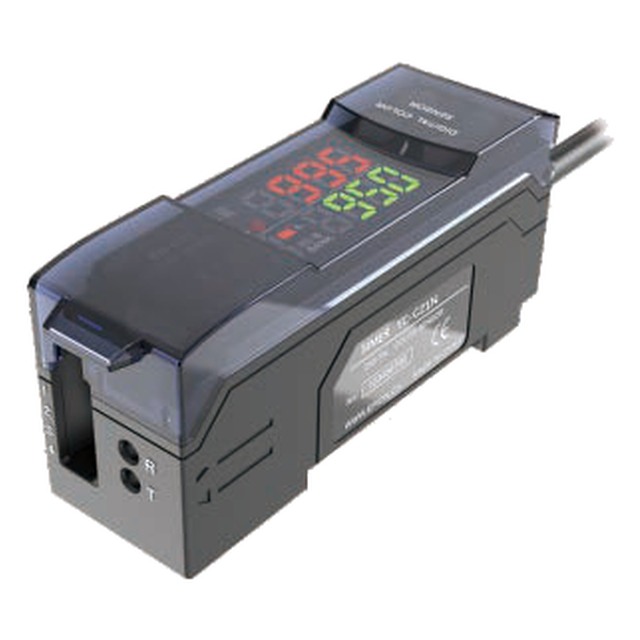
Dual spot compares the printed patch with the unprinted substrate next to it, so a change in paper shade does not cause a false trigger.
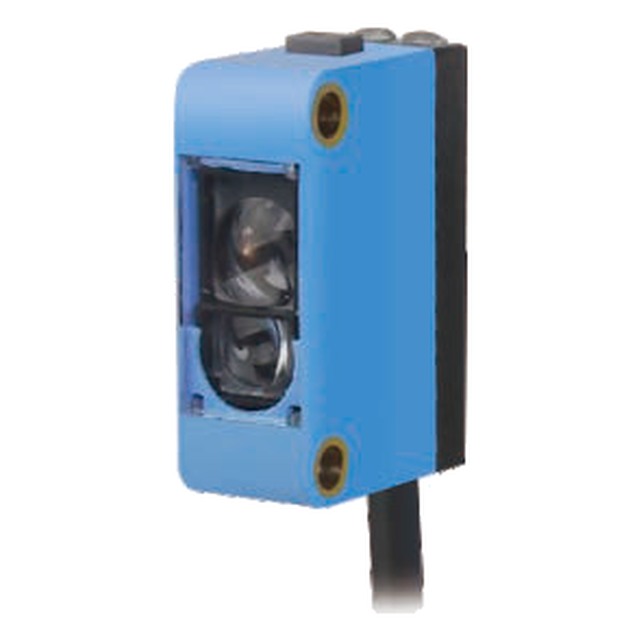
Verifies the printed panel colour on a wrapped product where the head cannot be close to the product.
Checks a colour-coded clip or a stitching colour on a seat cover.
Confirms that the carton belongs to the batch by its printed colour code.
| Series | EM-D70DS · EM-D70D · EM-D150D · EM-D500D (each available with -485) |
|---|---|
| Sensing distance | 30–700 mm (EM-D70) · 70–1500 mm (EM-D150) · 150–500 mm (EM-D500) |
| Light source | White LED |
| Response time | 200 µs / 1 / 5 / 10 / 20 / 100 / 500 ms (mode-dependent) |
| Minimum spot diameter | ≈7 mm at 50 mm (EM-D70) · ≈φ4.5 mm at 100 mm (EM-D150) · ≈11 mm at 250 mm · ≈20 mm at 500 mm (EM-D500) |
| Timer | OFF / ON-delay / OFF-delay / One-shot |
| Supply voltage | 12–24 V DC ±10 %, ripple P-P 10 % or less |
| Current consumption | ≤50 mA at 24 V DC · ≤110 mA at 12 V DC (excluding load) |
| Protection circuit | Power reverse connection, output short circuit, reverse output, surge absorption, load short circuit |
| Material | Zinc die-cast housing (nickel-chrome plated) · PC indicator cover · silicone button · glass lens cover · PVC cable & sleeve · SUS304 spot-adjustment dial |
| Model designation | D = single-spot · DS = dual-spot · -485 = I/O + RS-485 output |
| Item | Value |
|---|---|
| Head | Ø34.4 mm lens barrel, 2.5 mm proud of the face |
| Mounting holes | 2 × Ø3.5 through holes, 4 × Ø4.5 on the bracket pattern |
| Optical centre | 27.7 mm from the left edge, 17.4 mm from the top |
The three ranges share the same housing, so a bracket drilled for the EM-D70 works for the EM-D150 and the EM-D500 — only the working distance behind the lens changes.
| Lead | Colour |
|---|---|
| 2 | Blue |
| 3 | Black |
| 4 | White |
| 5 | Grey |
A mark on a web (colour mark), a printed colour against a reference (ΔE), or a shade that the eye cannot separate. Mark sensors work on contrast and are fast; the digital types work on a colour value and are repeatable.
The spot must be smaller than the mark for a mark sensor, and must sit entirely on the colour to be judged. A 2 mm spot on a 1 mm print register mark reads the paper as much as the ink.
White light separates similar colours; a single-colour LED is more robust on a shiny substrate but blind to metameric pairs. Where the colour difference is small, ask for the RGB-difference version rather than a contrast sensor.
Where one machine runs several products, order the version with four or eight stored references and switch them from the recipe in the PLC.
The head can sit outside a guard, behind a window or above a conveyor where a 20 mm sensor would be in the way — and still read a 10 × 20 mm colour patch.
The D versions project two spots, so a mark and its background are measured in the same instant. That removes the drift you get when one sensor tracks a slowly changing substrate.
Fast enough for a mark on a film running at several hundred metres a minute, and the mode is selectable when the surface needs more averaging.
Colour mode evaluates the spectrum and can 200 µs in the fast setting; slower settings up to 500 ms trade speed for stability on glossy or low-contrast webs. The fast figure applies when the sensor is used purely as a colour-mark detector.
Single spot when the substrate is stable and the mark contrast is high. Dual spot when the substrate shifts — recycled board, printed film with a drifting base colour, or a batch change mid-shift.
The spot grows with distance — ≈7 mm at 50 mm stand-off and ≈20 mm at 500 mm on the EM-D500 — so a mark smaller than the spot at that distance will not develop full contrast. If the mark is small, move the head closer or pick a shorter-range model.
Send your application details or the guard opening dimensions and we will specify the right model and configuration for your machine.