Chip presence under a tool
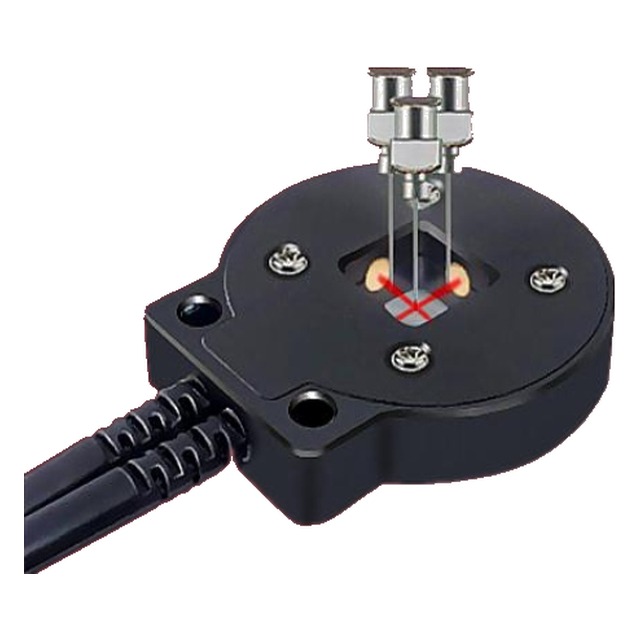
LEWY-F1.5 through a 2 mm hole in the fixture plate at 30 mm, Ø1 mm spot. The plain tip is glued into the plate and never moves.

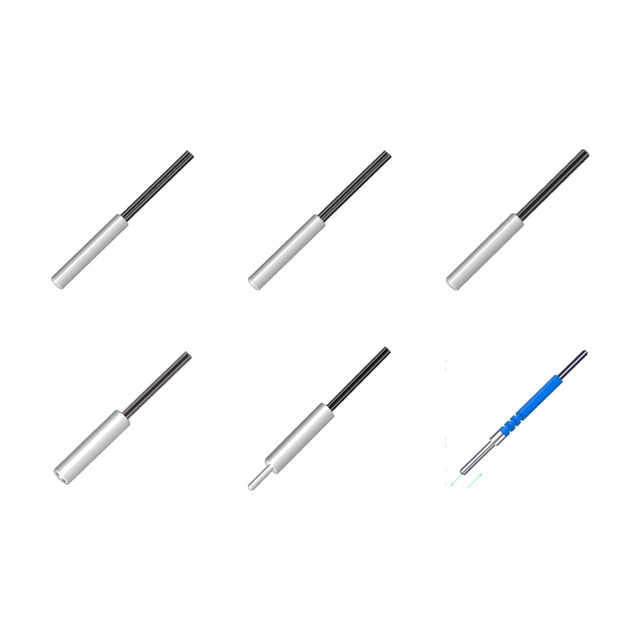
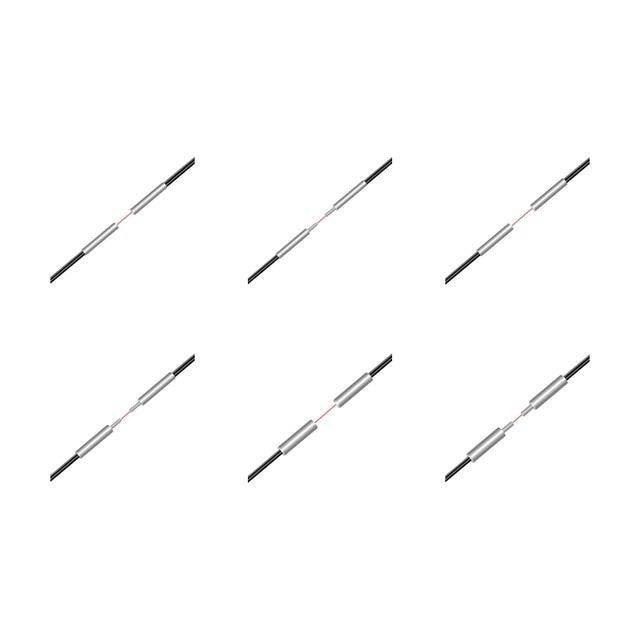
Thirteen diffuse units in one table: plain Ø1.5, 2, 3 and 5 mm tips for a drilled hole, M3 threaded bodies with a replaceable Ø0.9 or Ø1.5 mm tip, side-view
Model LEWY-F1.5 · LEWY-F2.0 · LEWY-F3.0 · LEWY-F5.0 · LERE-M310 · LERC-M310 · Brand LE Raun · Category: Fiber Optic Sensors
A fiber unit is a light pipe: it carries the amplifier's LED to the measuring point and the returning light back. Its two numbers — the core diameter and the bend radius — decide whether the amplifier sees enough light to switch reliably. Everything else in the table is packaging.The plain LEWY types are the low-cost route into a drilled hole or a machined slot. The threaded M3 types (LERE / LERS / LERC) add two nuts and a repeatable position, which matters as soon as a fixture is changed over. The coaxial LERC is the specialist: it looks down a bore, a nozzle or a drilled block where a side-by-side emitter and receiver would only see the wall.All of them are rated for −50 to +70 °C at the fiber, which covers a machine frame but not an oven — for that, the stainless units in the high-temperature family go to 350 °C.
LEWY-F1.5 through a 2 mm hole in the fixture plate at 30 mm, Ø1 mm spot. The plain tip is glued into the plate and never moves.
LERC-M310 coaxial, 60 mm, looking down the bore. The nine outer cores light the wall evenly and the centre core reads the bottom face.
LEWY-F5.0 at 180 mm with a Ø5 mm spot, amplifier in area mode — the curvature no longer breaks the return light.
LERS-M310TZ right-angle in an M3 tapped hole in the clamp body, beam parallel to the locating face, 50 mm to the part.
| Type | Diffuse (reflective) fiber unit — one fiber bundle, emitter and receiver in the same tip |
|---|---|
| Amplifier | Any LE or LG series amplifier in this chapter |
| Fiber length | 1 m standard; 1000 / 2000 mm to order |
| Sensing distance | 15 mm (LERE-M310) to 180 mm (LEWY-F5.0 / F5.05) |
| Tip diameter | Ø1.5 / Ø2.0 / Ø3.0 / Ø5.0 mm plain · Ø0.9 / Ø1.5 mm replaceable on the threaded types |
| Thread | M3P0.25 (LERE-M310) · M3P0.5 (LERS / LERC) · none on the LEWY plain types |
| Bend radius | R10 / R15 / R25 depending on the jacket |
| Ambient temperature | −50 to +70 °C at the fiber, −20 to +55 °C at the amplifier |
| Jacket | Stainless spiral armour on the threaded types, PVC on the plain types |
| Repeatability | Set by the amplifier, not by the unit |
| Item | Value |
|---|---|
| Jacket diameter at the amplifier end | Ø2.2 mm, fork terminal |
| Tip extension | Ø0.9 mm × 10 / 20 / 40 / 90 mm on the threaded types (replaceable tip) |
| Thread length | 13 mm (M3 types) · 12.7 mm total body on the right-angle types |
| Right-angle head | 7 mm across flats, 5.8 mm to the fiber axis |
| Mounting | Two M3 nuts on the threaded body, or a clamp on the plain tip |
Sensing distance is quoted against a white 100 × 100 mm target at the stated amplifier gain. A dark or angled target reduces it by 30–60 %.
| Core | Colour |
|---|---|
| 2 | Blue |
| 3 | Black |
| 4 | White |
A diffuse unit needs return light from the part itself: matt, at least 3 mm across, within 180 mm. A wire, a transparent film or a part further away needs a through-beam pair.
Ø0.9 mm tip for a 1 mm feature, Ø1.5 mm for general presence, Ø5 mm when the part position varies. The tip decides the spot; the amplifier only decides the threshold.
A threaded M3 body with two nuts gives 0.1 mm adjustment and a repeatable position after a changeover. The plain tips (LEWY) are for a drilled hole or a glued-in place where there is no room for nuts.
R10 units are the thin-jacket ones — they will follow a 10 mm radius but lose light on a tight coil. In a drag chain, take R25.
Every unit in the table plugs into the same Ø4 mm port, so a machine can start with a plain Ø1.5 mm tip and change to a threaded M3 body without touching the wiring.
LERC-M310 sends and receives along the same axis through nine Ø0.25 mm cores around one Ø0.5 mm core. It is the only type that sees the bottom of a 6 mm bore without seeing the wall.
The threaded types take Ø0.9 or Ø1.5 mm tips in 10, 20, 40 and 90 mm lengths — the same body reaches deeper into a fixture by changing a tip, not by re-routing the fiber.
The TZ versions turn the beam 90° in 5.8 mm, which is what a fixture with a part travelling parallel to the mounting face needs.
The catalogue value is measured on a white 100 × 100 mm target. A black, matt or angled part returns a fraction of that light. Use the catalogue figure to compare units, then teach on the real part.
No. Both ends are terminated and polished; cutting one end destroys the unit. Order the length you need — 1 m and 2 m are standard.
Looking into a bore or a narrow channel. Side-by-side fibers see the wall before they see the bottom; a coaxial unit puts the emitter ring around the receiver so the wall is lit evenly.
Send your application details or the guard opening dimensions and we will specify the right model and configuration for your machine.