Press infeed protection
Stops the press when two sheets arrive together, before the tool is damaged and before the part is scrapped.

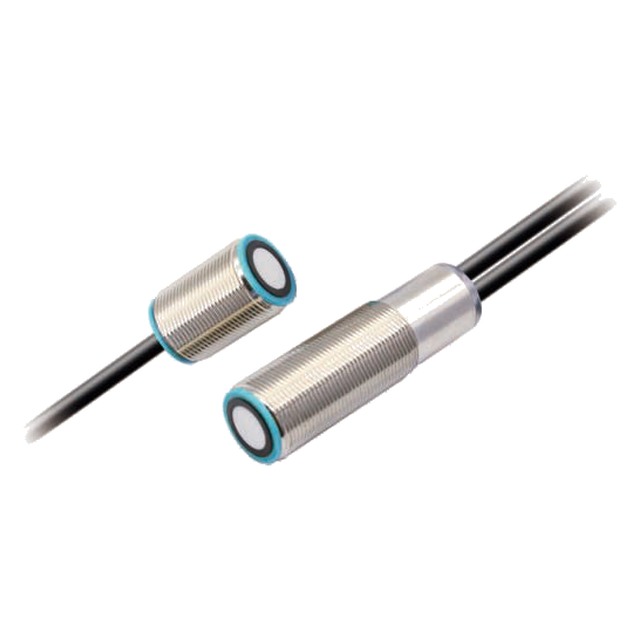
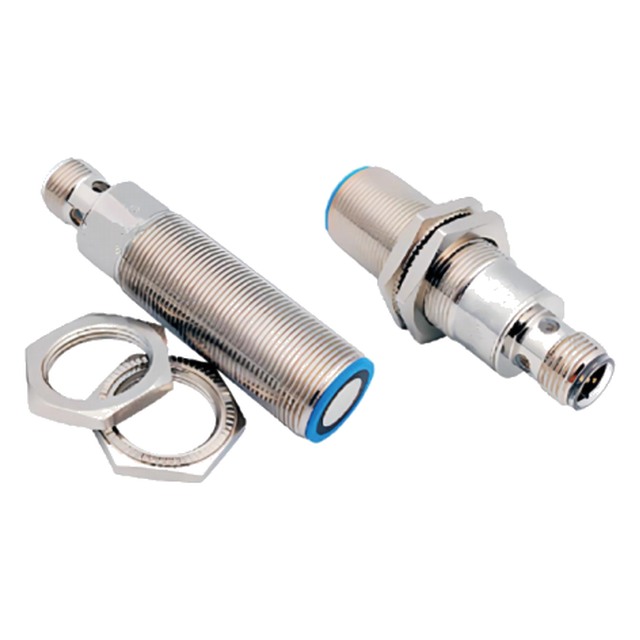
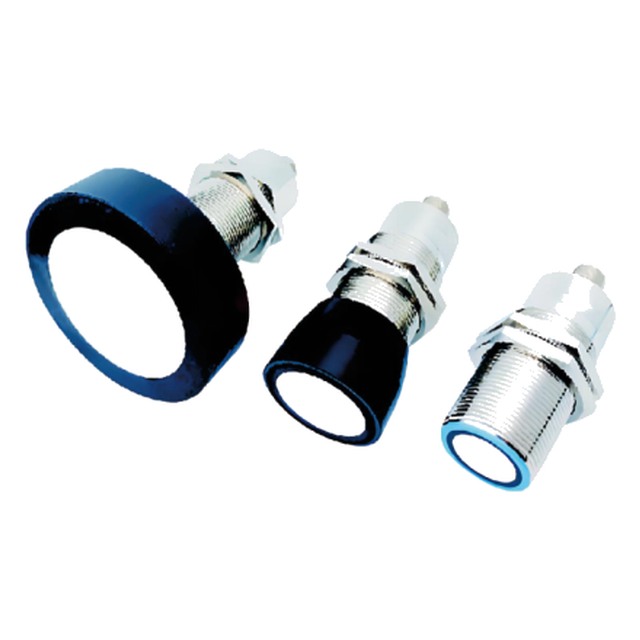
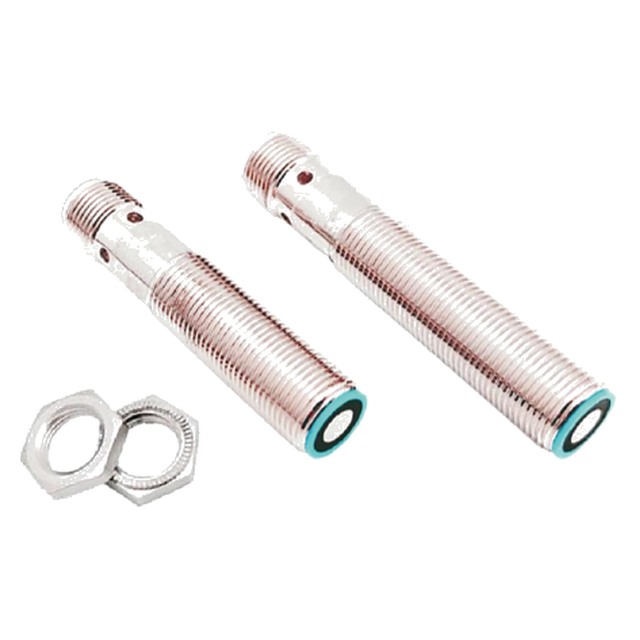
Detects two sheets fed where one should be: paper from 0.01 mm, metal sheet up to 3 mm, with green / yellow / red LEDs for single sheet, air and double sheet
Model LDA-18GM55-200-3E1(E2) / LDA-30GM55-100-3E1(E2) · Brand LE Raun · Category: Ultrasonic Sensors
A single/double-sheet detector is a pair of ultrasonic transducers facing each other across the material. The receiver measures how much of the pulse gets through; one sheet attenuates the signal by a known amount, two sheets by roughly twice as much, and no sheet by nothing. The three states map directly onto the three LEDs.That is why the operating range is written in terms of the material rather than in millimetres of air: the LDA18 is specified for metal composite sheets and films under 1 mm, adhesive labels, labels on paper substrate above 0.01 mm, PCB boards and silicon wafers. The LDA30 is the thicker-metal version, up to 3 mm of steel.The outputs are 3E1/3E2 for three NPN channels and 3E3/3E4 for three PNP channels, so the controller can read the state directly instead of inferring it from a single presence bit. Supply is 10–30 V DC, protection is IP67, and the ±45° angular tolerance means the bracket does not have to be precise.
Stops the press when two sheets arrive together, before the tool is damaged and before the part is scrapped.
Detects a double feed at the feeder head, where a single missed sheet ruins a whole signature.
Confirms that the liner carries a label and not a second liner — the 0.01 mm resolution is the point.
Detects a double layer of electrode foil or separator before the cell is wrapped.
Confirms that one board, not two, is on the conveyor before the pick-and-place cycle.
| Series | LDA18 (20–60 mm) · LDA30 (20–100 mm) |
|---|---|
| Output type | 3E1/3E2: 3 NPN switching outputs, NO/NC · 3E3/3E4: 3 PNP switching outputs, NO/NC |
| Indicators | Green LED = single sheet · yellow LED = no target (air) · red LED = double sheet |
| Materials | Brass sleeve, nickel-plated, plastic components; transducer in glass-filled epoxy resin |
| Maximum angular deviation | ±45° relative to the perpendicular plane |
| Operating voltage | 10–30 V DC |
| Ambient temperature | −25 to +70 °C (248–343 K) |
| Protection level | IP67 |
| Operating range (LDA18) | Metal composite sheets and films < 1 mm thick, adhesive labels, labels on substrate paper > 0.01 mm, PCB boards, silicon wafers |
| Operating range (LDA30) | Metal sheets < 3 mm thick |
| Principle | Reflected sound pulse; distance from time of flight |
| Range | 30 mm to 6 m depending on model, with a dead zone in front of the face |
| Repeatability | ±0.15 % of the measured distance |
| Beam angle | 8° – 15° half-angle depending on the transducer diameter |
| Temperature compensation | Built in over the full operating range |
| Item | Value |
|---|---|
| LDA30 | M30 × 55 mm thread, detection 20 – 100 mm |
| Mounting | Lock-nut on the thread; L-bracket optional on LDA18 |
| Cable | 2 m PVC, 4-pin |
| Pair | Emitter + receiver facing each other across the sheet path |
Both sensors are sold as a facing pair for single/double-sheet detection — the M18 covers the thin range and the M30 the thick, and the 55 mm thread is the same, so the bracket design carries over.
| Lead | Colour |
|---|---|
| 2 | Blue |
| 3 | Black |
| 4 | White |
| 5 | Grey |
Every ultrasonic sensor is blind for the first 30–100 mm. If the target comes closer than that, the reading jumps to the maximum — mount the sensor further back or choose a type with a shorter dead zone.
The cone is 8–15° half-angle: at 1 m a 15° cone is 500 mm across. In a narrow tank the walls answer instead of the liquid, which is why standpipes and stilling wells exist.
Soft foam, felt and open-cell sponge absorb the pulse; a surface at 45° reflects it away. Cloth, liquid and granular material are the easy cases.
Analogue for level, RS485 for a bus of sensors, switching for a simple high/low limit. Add the synchronisation lead whenever two sensors can see the same surface.
A normal presence sensor tells you “something is there”. This one tells you single sheet, no sheet or double sheet — which is the actual question at a press infeed.
The LDA18 resolves paper from 0.01 mm and foil from 0.1 mm; the LDA30 handles steel sheet up to 3 mm. Two bodies cover the printing and the metal-stamping trades.
±45° of angular deviation means the sensor does not have to be square to the sheet, which matters when the material flutters as it enters the press.
3E1 and 3E2 are the NPN versions, 3E3 and 3E4 are the PNP versions. Within each pair the two part numbers differ in the output logic. Match the transistor type to your PLC input card and the logic to your program.
No. It classifies into three states. If you need an actual thickness, an ultrasonic distance sensor pair or a laser displacement pair measures the sheet directly.
The attenuation of a 200 kHz pulse through steel is steep: beyond about 1 mm the transmitted signal is too weak to distinguish one sheet from two. The LDA30 uses a lower frequency and a larger transducer to reach 3 mm.
Send your application details or the guard opening dimensions and we will specify the right model and configuration for your machine.