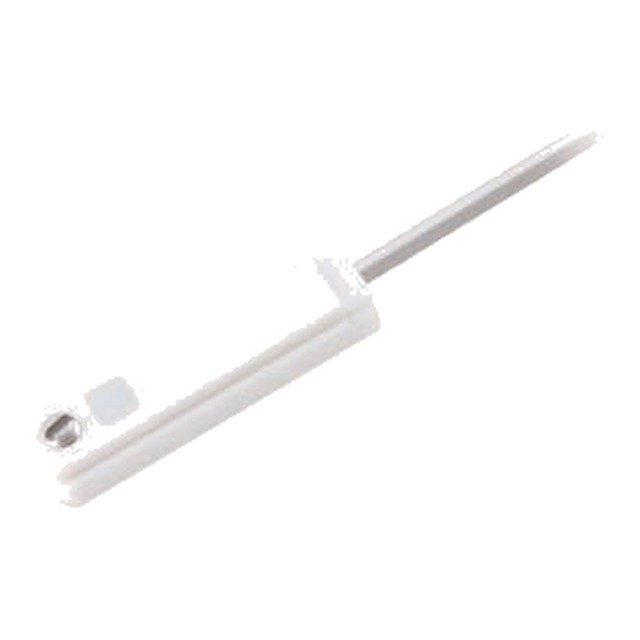
Cylinder end-position sensing
Confirms that a clamp, a slide or an ejector has reached its end of stroke before the next step of the cycle.

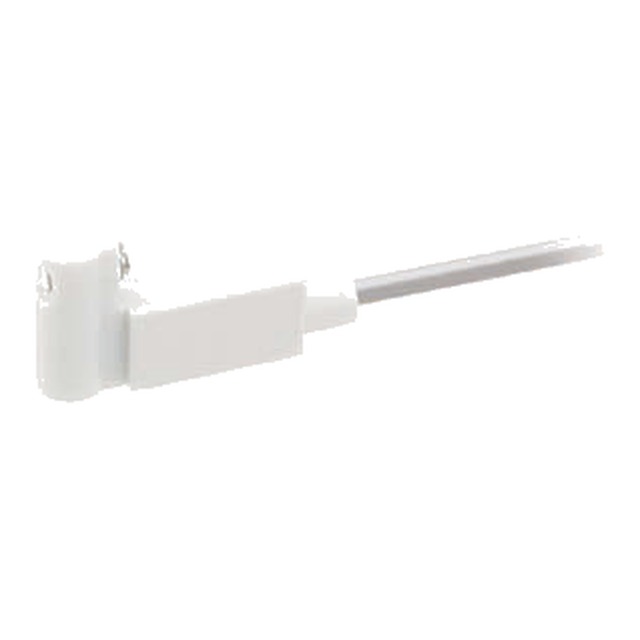
Fifteen non-contact magnetic switches for pneumatic cylinder grooves: 40–800 Gauss sensitivity, 2.5–100 mA switching, 1000 Hz and a red LED that shows the sw
Model D-A93 · D-Z73 · D-C73 · D-M9B / M9N / M9P · D-F8B / F8N · D-9D · D-BD · DMSM / DMSH / DMSG / DMSE / DMSJ · Brand LE Raun · Category: Magnetic Sensors
A magnetic switch is a small sensor that clips into the T-slot of a pneumatic cylinder. The piston carries a ring magnet; when it passes under the switch, the field operates a magnetoresistive element and the output changes state. Nothing touches the piston, nothing wears, and the switch can be slid along the groove to set the point where it triggers.The D series is the non-contact family: 40 to 800 Gauss sensitivity, 10–28 V DC supply, 2.5 to 100 mA switching current, 2.8 W maximum contact capacitance and 1000 Hz switching frequency, with 50 G shock and 9 G vibration resistance. Reverse-polarity and surge-absorption protection are built in.The body is IP64 as standard and IP68 in the waterproof version, rated for −10 to +70 °C, with a red LED indicator and a 2-core or 3-core oil-resistant PVC cable. Fifteen models cover the groove widths and cable exits used by the common cylinder ranges; the choice between them is mechanical fit rather than electrical performance.
Confirms that a clamp, a slide or an ejector has reached its end of stroke before the next step of the cycle.
Two switches on one gripper body report open, closed and — with both off — a part missing.
Detects the spool position on a large pneumatic valve where an electrical position sensor will not fit.
Two switches set the travel limits the controller uses for the sequence.
The IP68 version survives the wash-down that would fill a standard body with fluid.
| Sensor switch type | Non-contact type (magnetoresistive) |
|---|---|
| Sensing sensitivity | 40–800 Gauss |
| Supply voltage | 10–28 V DC |
| Max. switching current | 2.5 mA – 100 mA |
| Max. contact capacitance | 2.8 W max. |
| Max. switching frequency | 1000 Hz |
| Shock resistance | 50 G |
| Vibration resistance | 9 G |
| Protection circuit | Reverse-polarity protection · surge absorption protection |
| Operating temperature | −10 to +70 °C |
| Protection level | IP64 standard · IP68 waterproof type |
| Indicator lamp | Red LED |
| Cable | 2-core or 3-core, oil-resistant grey PVC |
| Product application | Determines quantity and mounting position according to cylinder control requirements |
| Switching voltage | AC/DC 100 V max. (reed), 24 VDC (solid state) |
| Response time | ≤1 ms |
| Item | Value |
|---|---|
| D-8D | 4.0 mm high × 13 mm long, 5.0 / 3.2 mm mounting faces |
| D-9D | 4 mm high × 14.5 mm long |
| DMSM | 23.2 mm long |
| 3045 | 29.4 × 10.4 mm |
| Lead | 150 ± 10 mm to the connector |
Every type drops into the same 6–8 mm groove on a cylinder barrel; the difference is the groove depth the body needs and whether the LED is visible from the side or the end.
| Lead | Colour |
|---|---|
| 2 | Blue |
| — | 3-wire types |
Cylinders differ in groove shape: a C-groove, a round groove or a tie-rod. The switch body is shaped for one of them, and no bracket will make a C-groove switch hold in a round groove.
A reed contact is cheap and works on AC or DC, but it bounces and welds under inrush. A solid-state switch has no moving contact — the right choice on a high-cycle line or in a weld field.
2-wire is simplest for a PLC input in series with the load; 3-wire gives a defined output and a shorter response time.
The switch operates over a band along the stroke, not at a point. Where the repeatability matters, order the narrow-band version and set it at mid-stroke.
A magnetoresistive element switches when the piston magnet passes. There is no reed contact to stick, which is why the switching frequency reaches 1000 Hz and the life is not quoted in operations.
Wide enough to pick up a weakly magnetised piston, narrow enough not to trigger on the next cylinder along the same block.
The standard body keeps dust out and splashes off; the waterproof version is what survives the coolant wash on a machine tool or a wet cell.
Reverse-polarity and surge absorption are inside the body, which matters on a machine where the 24 V rail is shared with contactors and brake coils.
The D series is the non-contact type — a magnetoresistive element with no moving parts, 1000 Hz and 2.5–100 mA at 10–28 V DC. The C series is the contact (reed) type, 200 Hz, 100 mA, 10 W, with a 10–240 V AC/DC supply. Use D for a high cycle rate, C where the circuit is 110 or 230 V AC.
Because the field at the switch depends on the piston magnet, the wall thickness of the cylinder tube and the gap in the groove. A wide window lets one switch work across several cylinder ranges; a narrow one would need a different part for every tube.
No. The switch needs the piston magnet. Aluminium or stainless cylinders without one require a different sensing principle — a proximity sensor on the rod, or a replacement magnetic piston.
Send your application details or the guard opening dimensions and we will specify the right model and configuration for your machine.