Strip and web thickness
Two heads facing each other across the material give a thickness reading that is independent of the line height; a single head against a reference roll does the same job when the material runs on a backing.

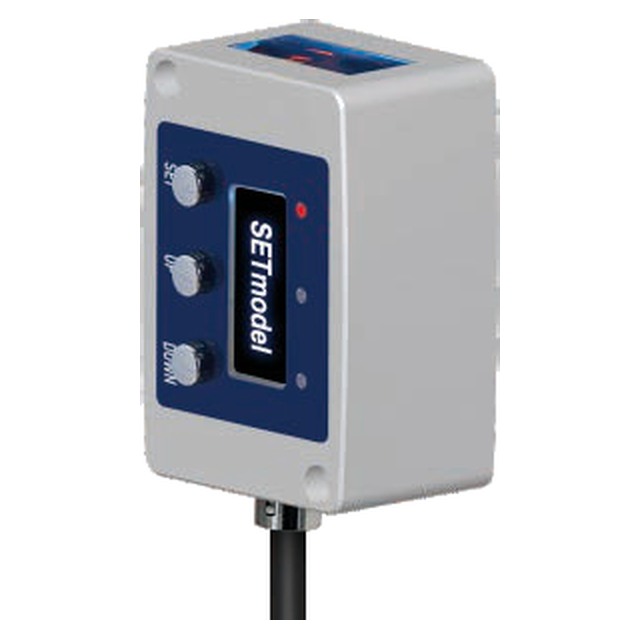
Four triangulation heads from 30–50 mm short range to 30–400 mm wide range, with ±1.5 µm repeat accuracy and NPN, PNP, RS485 or SSI output in the same 12–24 V
Model LE-G05 / LE-G10 / LE-G20 / LE-G40 · Brand LE Raun · Category: Laser Displacement & Profile
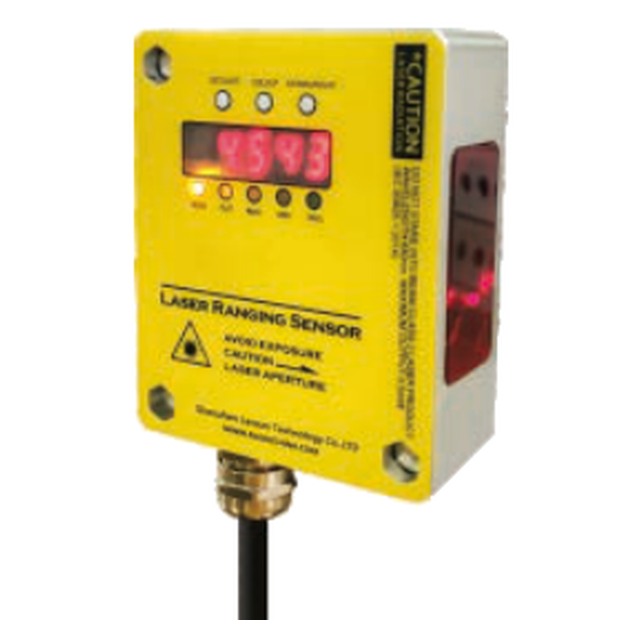
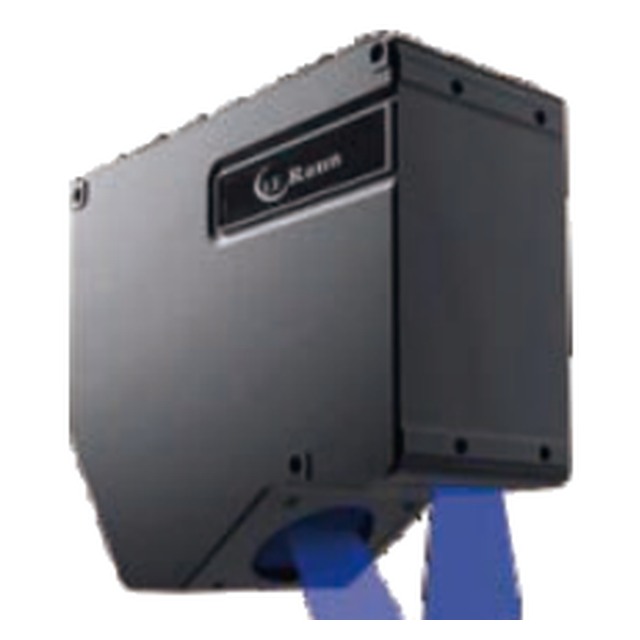
The LE-G series is a point triangulation sensor: a 660 nm laser diode projects a spot, a position-sensitive detector reads where the spot lands, and the controller converts that offset into a distance. Because the geometry is fixed, accuracy is highest close to the reference distance and falls away at the edges of the range — which is why four models exist instead of one.The LE-G05 is the short-range head: 30–50 mm with ±1.5 µm repeat, used where the target is fixed and the head can be bolted close. The LE-G10 and LE-G20 trade a little accuracy for a wider window, and the LE-G40 covers 30–400 mm with ±2.5 µm, which is the practical choice when the stand-off has to clear a guard, a nozzle or a moving carriage.All four run from 12–24 V DC with reverse-polarity and short-circuit protection and report status on three LEDs. Output is selected at order: NPN or PNP switching for a simple go/no-go, RS485 for a network of heads on one bus, SSI for a motion controller that wants a synchronous absolute value.
Two heads facing each other across the material give a thickness reading that is independent of the line height; a single head against a reference roll does the same job when the material runs on a backing.
Mounted on the bearing housings, the pair reports the gap directly, so the operator closes the nip to a number instead of to a feel.
The head checks that the part sits at the expected height in the gripper before the robot closes — a cheap interlock against a double-sheet pick.
Measures the bottom dead centre of the ram or the height of a formed part on the transfer, catching tool wear before it becomes scrap.
A 49 kHz-capable front end lets the sensor follow a moving surface, so the same head can log deflection of a beam or a spindle under load.
| Series | LE-G05 · LE-G10 · LE-G20 · LE-G40 |
|---|---|
| Detection distance | 30–50 mm (LE-G05) · 30–100 mm (LE-G10) · 30–200 mm (LE-G20) · 30–400 mm (LE-G40) |
| Repeat accuracy | ±1.5 µm (LE-G05, LE-G10) · ±2 µm (LE-G20) · ±2.5 µm (LE-G40) |
| Beam diameter | Approx. ø10 mm |
| Light source | Red semiconductor laser, 660 nm |
| Output modes | NPN · PNP · RS485 · SSI communication (optional) |
| Operating voltage | 12–24 V DC ±10 %, ripple P-P 10 % |
| Short-circuit protection | Equipped, auto-recovery type |
| Ambient illuminance | Incandescent lamp: illuminance at receiving surface ≤ 3 000 lx |
| Ambient temperature | −10 to +40 °C, no condensation or icing |
| Ambient humidity | 35–85 % RH, non-condensing |
| Indicators | Power · output · fault |
| Model designation | N = NPN · P = PNP output · R = RS485 output · S = SSI communication |
| Measuring principle | Laser triangulation (diffuse reflection) |
| Item | Value |
|---|---|
| Detection ranges | 30–50 / 30–100 / 30–200 / 30–400 mm — set by the model (LE-G05 / G10 / G20 / G40) |
| Mounting | Two through holes on the body centre line; the cable leaves from the rear |
The four heads share one mounting pattern, so the bracket does not move between models — only the detection range in the model number changes the stand-off you have to build.
| Connection | Function |
|---|---|
| Blue | 0 V |
| Black | Switching output / alarm |
| White | Analogue output (4–20 mA or 0–10 V) |
| Shield | Earth — bond at the controller end only |
Triangulation covers a few millimetres to about a metre with µm resolution; beyond that the time-of-flight models take over at millimetre resolution. Do not ask a 10 mm-range sensor to measure at 500 mm — the spot has already walked off the receiver.
A shiny machined face sends the beam away from the receiver, a black rubber part absorbs it, and a transparent film lets it through. Blue-laser models are the answer for hot, red-glowing or organic surfaces; a 45° mounting removes most mirror reflections.
Analogue for a fast control loop, RS485 when several sensors share one bus or when the reading has to be logged, switching output for a simple go/no-go.
A 1 µm sensor is only as good as its bracket. Thermal growth of an aluminium bracket over 10 °C is more than the repeatability of the sensor; use cast iron, granite or a short, stiff bracket.
±1.5 µm at short range is enough to gauge shim thickness, coating build-up or roll gap without touching the surface and without a granite stand.
NPN, PNP, RS485 and SSI versions share the same 12–24 V housing and the same mounting holes, so the electrical design does not change between machine generations.
The ø10 mm beam keeps the reading on a small feature instead of averaging the surrounding surface — the difference between measuring a rib and measuring the sheet next to it.
Only the output stage. N is NPN open collector, P is PNP open collector, R is RS485 and S is SSI synchronous serial. The optics, the housing, the supply voltage and the accuracy are identical, so the choice is made by the controller at the other end of the cable.
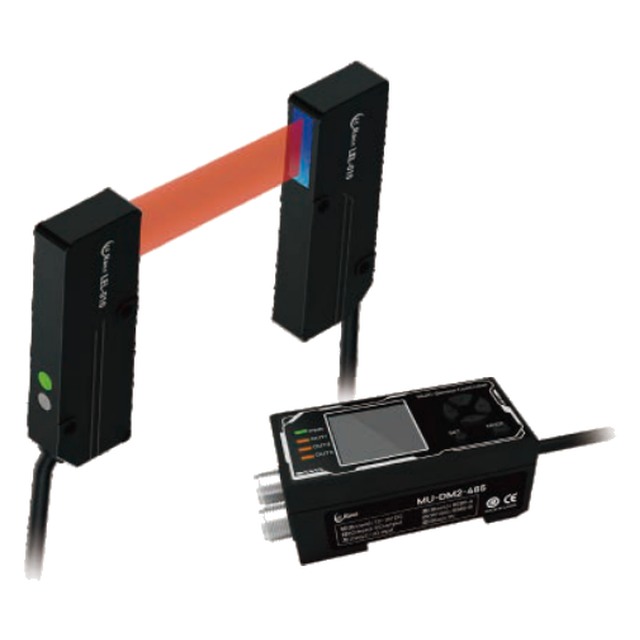
Triangulation depends on diffuse reflection back to the detector. Matt and machined surfaces are easy; a mirror finish deflects the beam away and a perfectly clear film passes it through. For those cases the catalogue offers the through-beam MU-DM2 edge sensor or an ultrasonic alternative, and we will test a sample before recommending a model.
The LE-G10, which covers 30–100 mm with ±1.5 µm repeat. If the stand-off has to be longer or the window wider, step up to the LE-G20 (30–200 mm, ±2 µm) or the LE-G40 (30–400 mm, ±2.5 µm).
Send your application details or the guard opening dimensions and we will specify the right model and configuration for your machine.