Light guard doors
Plastic and sheet-metal covers where a mechanical key would be over-specified.

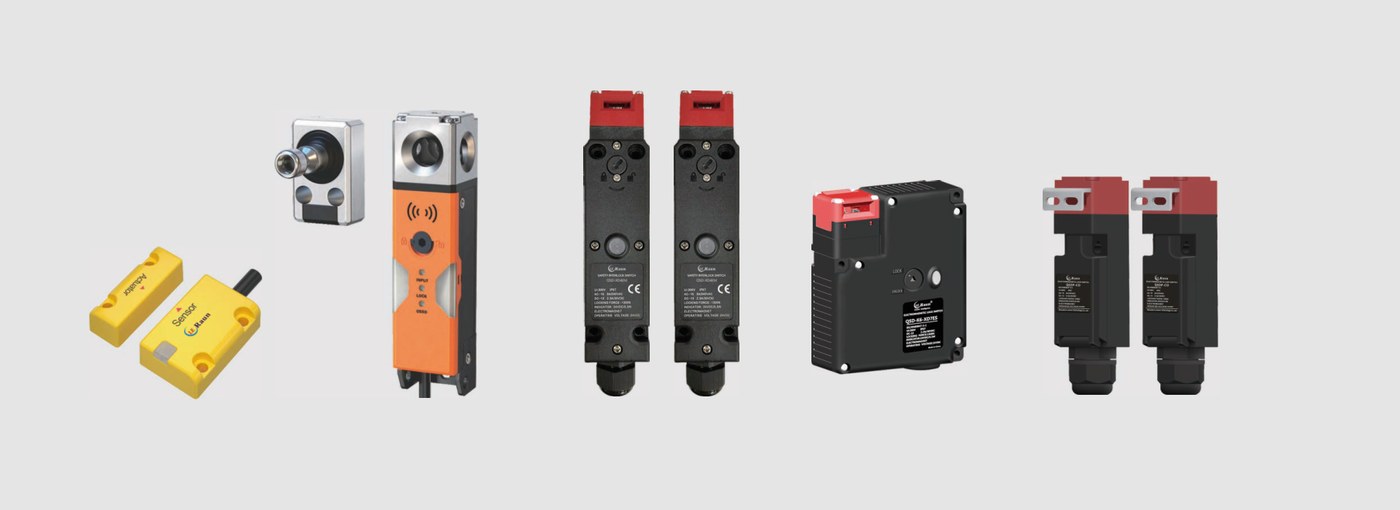
A magnetic-coded interlock with two safety output contacts and a wide 8 mm operating / 17 mm release window — a low-cost coded alternative where a mechanical
Model QSD-M01-2A / 1A1B / 2B -02 · Brand LE Raun · Category: Safety Door Locks & Interlocks
The QSD-M01 uses a magnetically coded target rather than an RFID tag. It is the simplest coded option: a reed-based pair with two safety output contacts, a 0–8 mm conduction distance and a release point beyond 17 mm — a wide window that tolerates doors which do not close to the same position twice.Three output configurations cover the usual wiring: two normally-open safety contacts, one of each, or two normally-closed. Sealing is IP65 as standard, with IP67 and IP68 available on request.
Plastic and sheet-metal covers where a mechanical key would be over-specified.
Monitors hinged gates on conveyors and sorters.
Detects opening of electrical or process enclosures.
Adds coded monitoring to a door that was previously unmonitored.
Several switches per machine at a lower unit cost than RFID.
| Model | QSD-M01-2A (1A1B / 2B) -02 |
|---|---|
| Cable outlet | Direct cable outlet, 2 m |
| Output type | 2 N.O. contacts · 1 N.O. + 1 N.C. · 2 N.C. contacts |
| Safety output | Two normally-open safety output contacts (N.O.) |
| Operating distance | Conduction 0–8 mm, open >17 mm |
| Operating current | 30 mA |
| Output current | 100 mA |
| Response time | 60 ms |
| Operating frequency | 1 Hz |
| Operating temperature | −10 °C to +55 °C |
| Relative humidity | 5%–95% |
| Protection level | IP65 / IP67 / IP68 (custom) |
| Product application | Suitable for CNC machine tools, injection-moulding equipment, semiconductor manufacturing equipment, etc. It ensures that the machine does not perform hazardous movements when the safety guard door is opened. |
| Housing material | Flame-retardant thermoplastic (metal body on the high-performance series) |
| Contact material | Silver alloy |
| Contact resistance | ≤25 mΩ |
| Rated insulation voltage | 500 V |
| Rated impulse withstand | 4 kV |
| Utilisation category | AC-15 / DC-13 |
| Mechanical life | 1,000,000 operations |
| Electrical life | 500,000 operations |
| Ambient temperature | −25 … +80 °C, no icing |
| Item | Value |
|---|---|
| Magnet offset | 5 mm or 15 mm, chosen by which face of the switch the magnet approaches |
| Matching magnet | Φ13.5 × 8 × 8 mm, supplied with the switch |
| Cable | 2 m, direct outlet |
The 5 mm and 15 mm figures are the two switch-on distances the data sheet plots; mount at the smaller one where the door can slam, and at the larger one where paint or swarf builds up on the faces.
| Terminal | Contact |
|---|---|
| 21 – 22 | NC, positive opening (second circuit) |
| 33 – 34 | NO |
| 41 – 42 | NO (where fitted) |
Monitoring only (mechanical interlock) is enough where the machine stops within the time the door needs to open. Locking is required where a spindle, press or robot arm keeps moving after the stop command.
Mechanical actuation is the simplest and cheapest. RFID and magnetic coding resist defeat with a spare actuator, tolerate misalignment and are the usual choice on washdown or vibrating guards.
Count the circuits: two NC for a dual-channel safety input, one NO for the door-closed signal to the PLC, plus one more NO if the lock state has to be reported separately.
Fzh is the force the lock withstands before the guard can be pulled open. Large sliding guards and guards with a long lever need the 2,000 N class rather than the 1,300 N class.
The actuator swings on the door hinge; the catalogue gives the minimum door radius for each model. Below that radius the actuator will bind and the switch will wear out.
Conducts up to 8 mm and only releases beyond 17 mm, so a rattling door does not cause nuisance stops.
2 N.O., 1 N.O. + 1 N.C. or 2 N.C. to match the safety circuit.
A magnetic target has no lever arm to knock out of alignment.
Magnetic coding is cheaper and has a wider operating window; RFID is harder to defeat and tolerates washdown better. Both are non-contact.
Two safety output contacts, normally open (N.O.), with 1A1B and 2B variants available for different circuit arrangements.
The output opens beyond 17 mm, giving a 9 mm hysteresis band over the 8 mm conduction point.
Send your application details or the guard opening dimensions and we will specify the right model and configuration for your machine.