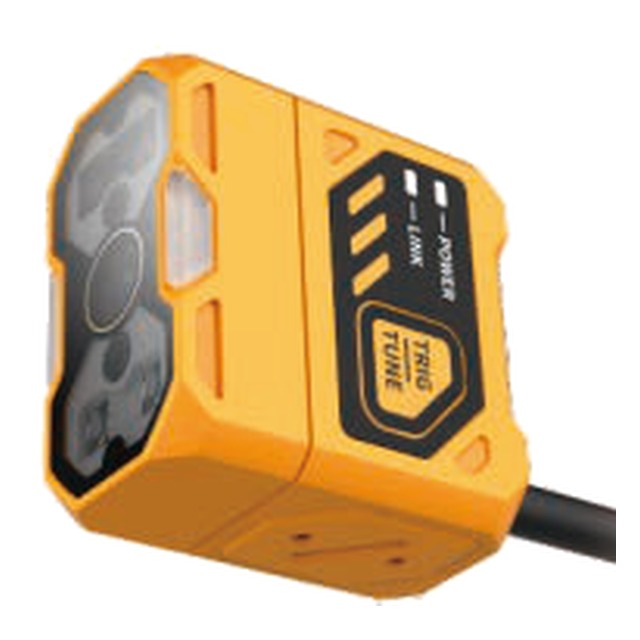
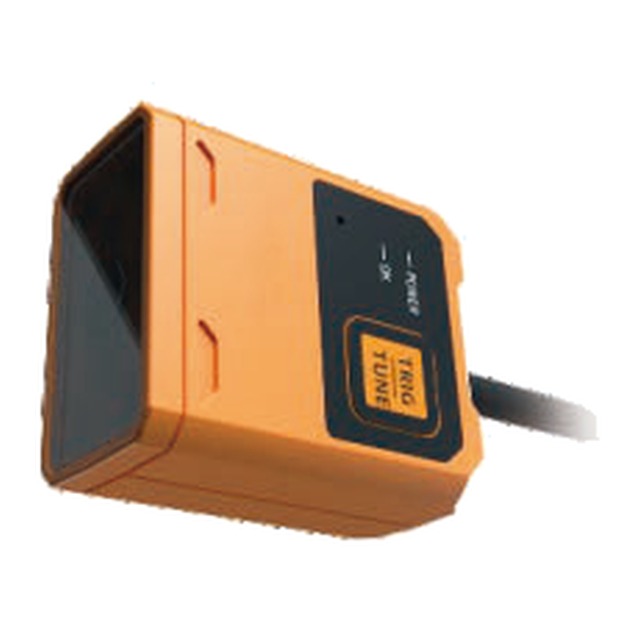
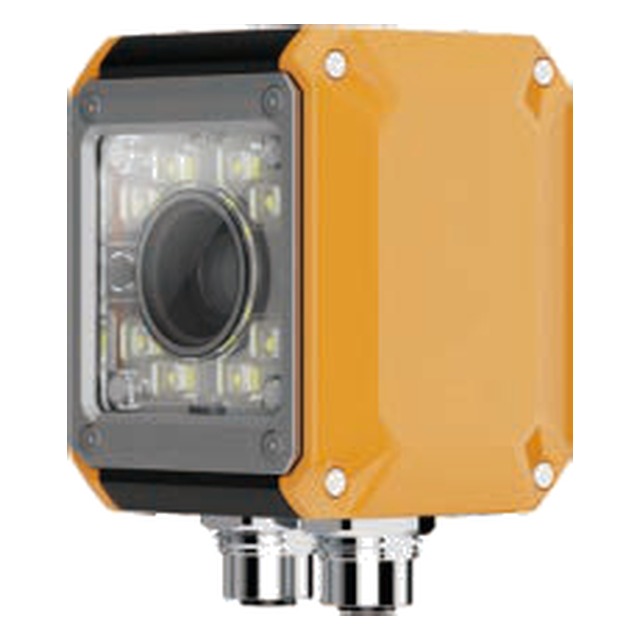
Multi-height inspection with one sensor
The liquid-focus body refocuses between two part heights instead of needing two fixed-focus sensors and two brackets.

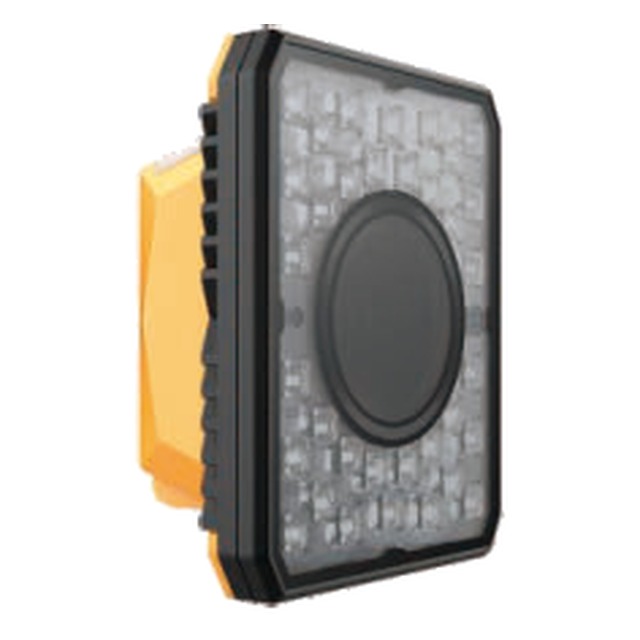
5 MP (2448 × 2048) on a 1/1.8" target, in focal lengths from 8 to 25 mm, with a mechanical focus ring on four bodies, a liquid-focus version, and two C-mount
Model LE2000P-521 / 522 / 523 / 524 / 530 · LE2000P-52C / 202C · Brand LE Raun · Category: Smart Code Readers
The LE2000P sits above the LE1000P on sensor size: 5 MP on a 1/1.8" target instead of 1 or 2.3 MP on 1/4", with the same 3 µm pixel, the same global shutter and the same 24 V DC / 15 W supply. What changes is how much of the scene fits in one frame, and how far away the sensor can be while still resolving it.Six bodies share that sensor. Four are fixed-focal with a mechanical focus ring — 8, 12, 16 and 25 mm — and one replaces the ring with a liquid lens at 16 mm. The last two are C-mount bodies with no built-in optics: the 52C keeps the 5 MP sensor, the 202C moves to 20 MP at 5472 × 3648 for the applications where 5 MP is not enough.The six-digit suffix on each part number encodes the variant within the family — connector, cable and output options — rather than a change in optics or sensing. The catalogue does not publish the suffix table, so order by the exact part number and confirm the suffix meaning with the factory.
The liquid-focus body refocuses between two part heights instead of needing two fixed-focus sensors and two brackets.
A C-mount body with an external lens views a wide belt from above the guarding, out of the way of the product flow.
At 25 mm and 5 MP the field of view is narrow enough to resolve print edges and surface marks that a wider lens would average away.
Confirms that every component on a small assembly is present — screws, gaskets, connector housings — in one frame rather than several.
Where the fixture blocks access, the C-mount body is mounted outside and the lens does the work.
| Focal length | 8 mm (521) · 12 mm (522) · 16 mm (523) · 25 mm (524) · 16 mm liquid focus (530) · selectable with an external C-mount lens (52C / 202C) |
|---|---|
| Resolution | 5 MP (2448 × 2048) on the 521 – 530 and the 52C · 20 MP (5472 × 3648) on the 202C |
| Focus adjustment | Mechanical focus (521 – 524) · liquid focus (530) · C-mount (52C / 202C) |
| Shutter | Global |
| Exposure time | 2.74 µs minimum — the catalogue prints the range as 2.74 μm – 2.74 μm |
| Pixel size | 3 µm × 3 µm |
| Sensor target size | 1/1.8" |
| Power input | 24 V DC |
| Power consumption | 15 W |
| Operating temperature | 0 to +45 °C |
| Protection level | IP67 |
| Frame rate | up to 60 fps |
| Code types | 1D barcodes, 2D codes (Data Matrix, QR, PDF417) and direct-part marking (DPM) |
| Minimum module | 0.1 mm (3 mil) at the rated working distance |
| Lighting | Built-in white, red or blue LED; polarised option for shiny parts |
| Interface | Ethernet TCP/IP, RS232, RS485, digital I/O, trigger input |
| Item | Value |
|---|---|
| Lens barrel | projects 40 mm in front of the face on the standard and C-mount bodies |
| High-power body | 108.5 mm wide, 65.3 mm deep |
| C-mount body | 74.5 × 100.5 mm face, 93.1 mm deep to take an external lens |
| Mounting | 4 × M4, 5 mm deep, on the front flange (2 × M4 on the high-power body) |
Order the bracket from the body you actually receive: the C-mount version is 45 mm deeper than the standard one, so a guard cut for the standard reader will not clear the lens.
| Connection | Function |
|---|---|
| M12 8-pin, pin 2 | Trigger input (PNP, 5–24 V) |
| M12 8-pin, pin 4 / 5 | Result outputs — good read / no read |
| M12 8-pin, pin 6 / 7 | RS232 TX / RX |
| M12 4-pin D-code | Ethernet 100 Mbit/s |
| — | Earth stud on the housing |
Measure the module size (the width of the narrowest bar) and the field of view you need. A 0.1 mm module needs roughly 3 pixels per module, which sets the resolution and the working distance.
FOV = sensor width × working distance ÷ focal length. A 5 MP sensor with a 16 mm lens at 300 mm covers about 190 × 120 mm — enough for a label with margin.
Printed labels read with white light; laser-marked or dot-peened DPM codes need low-angle red or blue light and a reader with a DPM algorithm. Ordering a label reader for a DPM code is the most common mistake in a traceability project.
Ethernet for a PC, an MES or a PLC with a socket; RS232 for a legacy terminal; digital I/O when the reader only has to say good / no-read to a relay.
2448 × 2048 gives roughly three times the pixel count of a 1 MP sensor over the same field, so a feature that had to fill a quarter of the frame can now be resolved at a tenth of it — or the same detail can be seen from a working distance three times longer.
The focus element is a liquid lens rather than a moving glass assembly, so the focal plane can be moved between two heights without a mechanical actuator. Useful where the part height varies and a fixed lens cannot hold both in focus.
The 52C and the 202C carry no built-in optics: they take a standard C-mount lens, which is how the same body covers a 20 MP sensor or a working distance of several hundred millimetres.
Same shutter and the same 15 W / 24 V DC supply on all seven part numbers, so the electrical design does not change when the lens does.
The 202C. It is a C-mount body on a 20 MP sensor, so a good 25 mm C-mount lens gives the same field of view at roughly four times the pixel count of the LE2000P-524.
No. It is a focus element that can be moved electrically; the sensor does not hunt for focus on its own. The two focus positions are set by the controller, which is what makes it repeatable for a two-height inspection.
The catalogue prints "2.74 μm – 2.74 μm" for this family, with the same figure at both ends and with length units. The lower limit is 2.74 µs; the upper limit is not stated in the brochure, so ask the factory for the full exposure range before specifying a long integration.
No. The 52C and 202C are bodies only — the C-mount is the interface. Order a lens matched to the working distance and the sensor size; a lens that covers 1/1.8" is required, otherwise the corners vignette.
Send your application details or the guard opening dimensions and we will specify the right model and configuration for your machine.