Manual jog on a CNC
The pendant lets an operator move an axis by hand while watching the readout, without reaching into the machine.

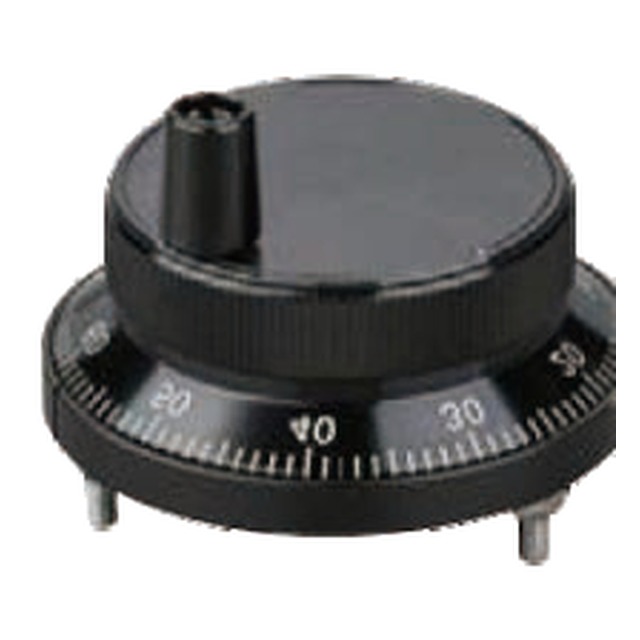
A graduated handwheel with a built-in encoder and a hand-held pendant, both at 25 or 100 pulses per revolution, for manual positioning on a machine that read
Model LE60 Handwheel · LE80 Handwheel · LERS T1469 Hand-Held Unit · Brand LE Raun · Category: Encoders & Draw-Wire
Not every axis needs a servo. On a manual mill, a printing-press compensator or a test stand, the operator turns a wheel and needs a number — and a handwheel encoder is the cheapest way to produce that number. The wheel is graduated so the eye can judge a partial turn, and the encoder behind it gives the counter an exact count.The LE60 and LE80 are 60 mm and 90 mm wheels on a 50 mm bore, so they replace the existing handwheel on a lead-screw end or a line shaft. The LERS T1469 is a free-standing unit at 134 × 69 mm, held in the hand like a pendant, for jogging an axis from the operator side of the machine.All three are offered at 25 or 100 pulses per revolution. The choice is the trade between speed and resolution: 100 PPR is finer, 25 PPR traverses four times faster for the same wrist movement. Output stages follow the rotary range — open collector, voltage, complementary, push-pull, 5 V line driver or 24 V line driver — so the handwheel can be wired to the same counter or PLC input as the axis encoder.
The pendant lets an operator move an axis by hand while watching the readout, without reaching into the machine.
A handwheel with an encoder turns a manual axis into a counted one for a DRO retrofit.
A handwheel on the compensator roller gives the operator a calibrated correction instead of a guess.
Approach a probe or a fixture by hand and read the exact travel on the counter.
Adding a handwheel and a counter is cheaper than replacing the axis drive when the machine only needs a position display.
| Models | LE60 Handwheel · LE80 Handwheel · LERS T1469 Hand-Held Unit |
|---|---|
| Outer dimension | 60 mm (LE60) · 80 mm (LE80) · 134 × 69 mm (LERS T1469) |
| Shaft bore / mounting | 50.8 mm bore (LE60) · 72 mm bore (LE80) · free-standing pendant (LERS T1469) |
| Pulses per revolution | 25 · 100 |
| Output stage | C open collector · E voltage · F complementary · L 5 V line driver (LE60 / LE80 handwheels) · LERS T1469 additionally T push-pull and A 24 V line driver |
| Resolution | Incremental 100–5000 ppr; absolute up to 17 bit single-turn / multi-turn |
| Output circuit | Push-pull, open collector, line driver (RS422), SSI or RS485 |
| Supply | 5–30 VDC (5 V for the line-driver versions) |
| Output frequency | 200 kHz (PNP: 100 kHz) |
| Protection | IP54 as standard, IP65 / IP68 for washdown and outdoor |
| Operating temperature | −20 … +70 °C |
| Item | Value |
|---|---|
| LE80 handwheel | Ø80 mm, 72 mm shaft bore |
| LEESTI469 pendant | 134 × 69 mm, free-standing |
| Pulses | 25 or 100 per revolution on both wheels |
The bore is the number that matters: 50.8 mm is 2 inch, so the LE60 drops straight onto a 2 inch shaft without a bushing, while the LE80 needs a 72 mm shaft or an adapter.
| Lead | Colour (typical) |
|---|---|
| 0 V | Blue |
| A / A̅ | White / Green |
| B / B̅ | Yellow / Grey |
| Z / Z̅ | Pink / Red |
| Shield | — |
Incremental for speed, length and simple positioning where the controller homes on power-up. Absolute where the position must be known without a homing cycle — a rotary table, a lift, a valve actuator.
Resolution = travel per revolution ÷ ppr. A 5 mm ball screw with a 2500 ppr encoder gives 2 µm per count before quadrature, 0.5 µm after — finer than the mechanics can hold.
Open collector for a short cable into a PLC, push-pull for a few metres, line driver for long runs or high frequency, SSI/RS485 for absolute multiturn.
Clamp or hollow-shaft mounting removes the coupling and the alignment problem; a solid shaft needs a flexible coupling and a bracket with slotted holes.
The wheel is graduated so the operator can judge a partial turn, and the encoder behind it gives the counter an exact number for the same movement.
100 PPR on a 5 mm-pitch screw is 0.05 mm per pulse — 0.0125 mm per count in four-times decoding. 25 PPR gives 0.2 mm per pulse but four times the traverse for the same wrist movement.
Open collector, voltage, complementary, push-pull and 5 V or 24 V line driver, so the handwheel can drive the same input card as the axis encoder.
The LE60 and LE80 replace the existing handwheel on a shaft end; the LERS T1469 is held in the hand for jogging an axis from the operator side of the guard.
It is an encoder with a wheel on the shaft: turning it produces a pulse train, and a counter or a CNC converts that into a position. There are no detents and no contacts to wear.
Because a hand turn is slow and the resolution is set by the screw, not by the encoder. 100 PPR on a 5 mm screw is already finer than an operator can judge by eye, and a higher count would only make the number run away during a fast traverse.
If the machine expects a differential A/B pair, order the L or A line-driver version; if it expects an open collector, order C. The mechanical fit — 50 mm bore — is the same for the LE60 and LE80.
Send your application details or the guard opening dimensions and we will specify the right model and configuration for your machine.