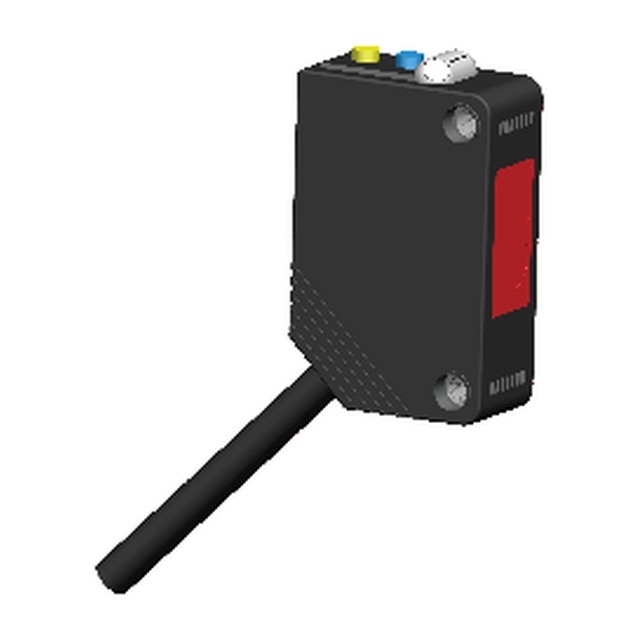
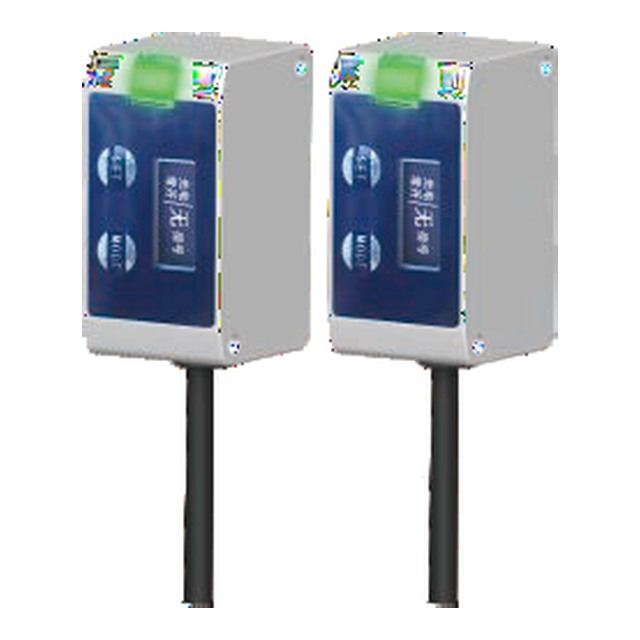
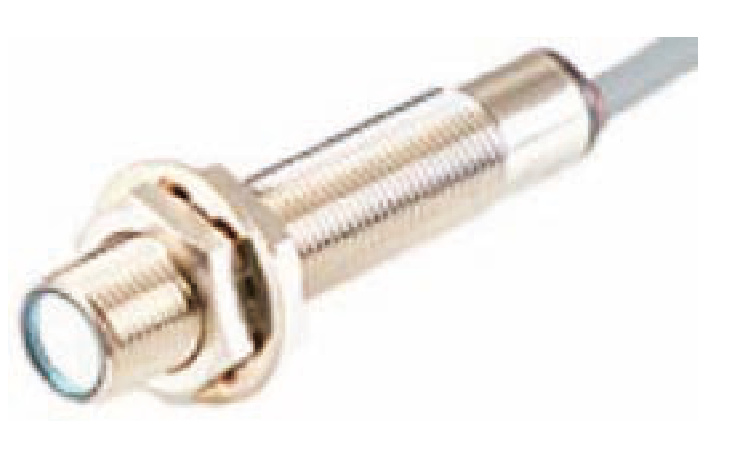
PCB and electronic component positioning
A 3 mm spot locates a connector or a fiducial on a board.

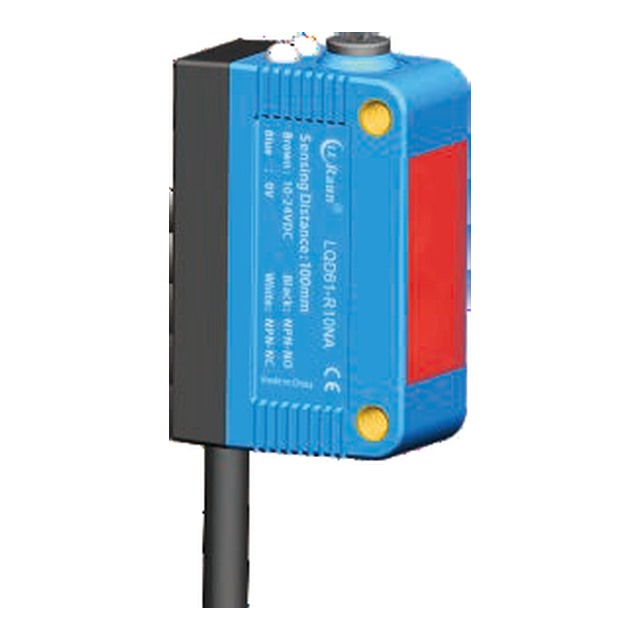
A 3 mm laser spot across 10 mm to 30 m: through-beam laser pairs, background-suppressed triangulation from 10 mm to 1 m, and a one-touch variant that learns
Model LQD61-T / R / MK · Brand LE Raun · Category: Laser Sensors
A laser triangulation sensor keeps its spot small over the whole range — 3 mm at any distance — so the detection does not degrade as the target moves further away. That is the difference from an LED photoelectric sensor, whose beam has already spread to 30 mm by the time it reaches 300 mm, and it is why these sensors are used for small parts, fine gaps and thin wires.The family covers three jobs. The through-beam pair reaches 30 m for long-distance positioning of ultra-thin objects. The background-suppressed versions set a distance window, so a shiny or dark background behind the target is ignored — R10A and R20A for close work, R100A out to 1 m with IO-Link for parameter readback. The MK30 uses one-touch setting: press the button with the target in place and the threshold is learned, which removes the usual trial-and-error adjustment.
A 3 mm spot locates a connector or a fiducial on a board.
Finds a 0.5 mm hole in a stamped part at 100 mm.
Separates two materials at the same height by the light they return.
The 30 m through-beam pair detects a wire or a sheet at the far end of a machine.
Confirms a small part is between the fingers.
| Models | LQD61-T3000N(P) · LQD61-R10N(P)A · LQD61-R20N(P)A · LQD61-R10N(P)T · LQD61-R100N(P)A · LQD61-MK30N(P) |
|---|---|
| Detection method | Through-beam · diffuse reflection with background suppression |
| Detection distance | 30 m (T3000) · 10–100 mm (R10A) · 25–300 mm (R20A) · 300 mm (R10T) · 30–1,000 mm (R100A) · 30–200 mm (MK30) |
| Spot size | 3 mm ±10% |
| Output mode | NPN or PNP open collector, < 100 mA (30 V DC) |
| Response time | ≤ 5 ms (T3000 / R100A) · ≤ 3 ms (R10A / R20A) · ≤ 0.5 ms (R10T / MK30) |
| Light source | Semiconductor laser diode (655 nm) · laser diode 650 nm on T3000 |
| Sensitivity adjustment | Single-turn adjuster · multi-turn (R10A / R20A / R100A) · one-touch setting (MK30) |
| Operating voltage | 12–24 V DC ±10% (10–30 V DC on T3000) |
| Protection level | IP65 |
| Cable outlet type | 2 m 4-core cable (2 m 3-core on T3000) |
| Insulation resistance | ≥ 20 MΩ between all power terminals and housing (tested with DC 250 V high-resistance meter) |
| Product application | PCB circuit board inspection, electronic component positioning, object presence / absence detection, micro hole detection, gap detection, coplanar different-material detection, small workpiece detection |
| Circuit protection | Short-circuit, reverse polarity, over-current |
| Item | Value |
|---|---|
| Mounting holes | 25.0 ±0.1 mm centres, 2 × M3 brass inserts |
| Optical axis height | 10.5 mm from the base to the lens centre |
| Lens aperture | Ø6.8 mm, 1.0 mm rim |
| Cable | 2 m, 3-core, 2 m flying lead (standard) |
The two M3 inserts are brass, so the body can be clamped hard without cracking the ABS shell — but the 25 mm centres are the only fixing points; there is no slot for adjustment, so shim the bracket instead.
| Lead | Colour |
|---|---|
| 2 | Blue |
| 3 | Black |
| 4 | White |
| — | Grey |
Through-beam for the longest range and the sharpest edge; retro-reflective for one-sided wiring; diffuse with background suppression where the object must be distinguished from the machine frame; time-of-flight where the range exceeds a few metres.
The spot grows with distance: a 1 mm spot at 300 mm may be 5 mm at 2 m. For a thin wire or a small hole, choose a model with a small spot at that specific distance.
A switching output answers 'is it there'; an analogue or RS-485 output answers 'where is it'. Positioning tasks need the analogue or the serial version, not a teach-in threshold.
Shiny, black or transparent targets change the received power; the BGS types are set on distance rather than on intensity, which is why they hold on a black part against a bright background.
Detects small parts and fine gaps at any distance, not just close up.
A distance window, not a light threshold — dark and shiny backgrounds stop causing false triggers.
Learns the threshold from the actual target, so no potentiometer adjustment is needed on the line.
Laser when the target is small, the distance is large or the background is close behind it. An LED sensor is cheaper and sufficient for a 50 mm carton at 300 mm.
Yes — class 1, eye-safe under normal use, no additional protective measures required.
A faster version: ≤ 0.5 ms response against ≤ 3 ms on the R10A, with a fixed 300 mm range.
Send your application details or the guard opening dimensions and we will specify the right model and configuration for your machine.