Presence of a 0.4 mm contact in a connector
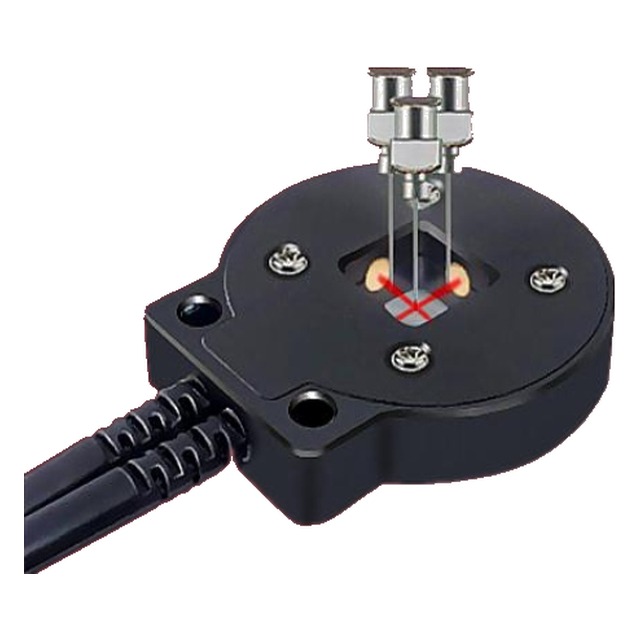
A Ø0.25 mm core through-beam unit (LETE-M310) across the insertion track, LE-025N at P100. The small spot is what makes the difference: a diffuse unit would see the housing, not the contact.

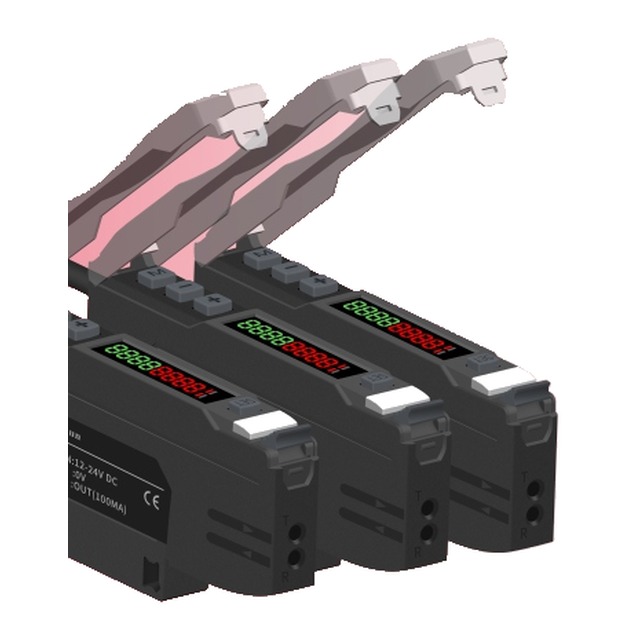
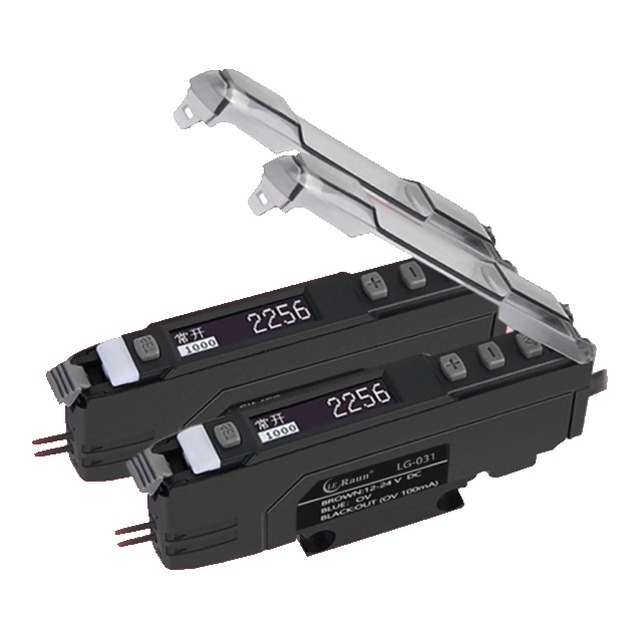
One 33.9 × 11.2 × 75 mm body with two four-digit displays — threshold on top, measured value below — and a response time that is a parameter rather than a
Model LE-021N / LE-021P · LE-025N / LE-025P · Brand LE Raun · Category: Fiber Optic Sensors
The amplifier is the part of a fiber-optic system that stays on the machine: the fiber unit is consumed, replaced, bent and cut to length, while the amplifier is wired once into the cabinet or the machine frame. That is why this family is built around one body with a parameter set rather than around a single response time — the same stock item covers a 16 µs edge detection and a 16 ms detection through a dusty enclosure.Both bodies mount on the machine frame with a single M3 screw through the side slot, or on a 35 mm DIN rail with the rail bracket. The fiber port is on the front face, the two displays on top, and the four setting keys on the upper face, so a row of amplifiers can be set from above without removing them.Everything the amplifier measures comes through the fiber unit: the unit decides the spot size, the sensing distance and the temperature the light path survives. Choose the unit first in a hot or narrow place, then choose the response mode that the resulting light budget allows.
A Ø0.25 mm core through-beam unit (LETE-M310) across the insertion track, LE-025N at P100. The small spot is what makes the difference: a diffuse unit would see the housing, not the contact.
Four LE-025N amplifiers in one row, white cores chained, each on a Ø1 mm through-beam pair. One master sets the timing for the group so the four beams do not talk to each other.
Diffuse unit LEWY-F3.0 at 50 mm, 500 µs mode. The amplifier's area mode averages over the label width, so a printed pattern does not read as a gap.
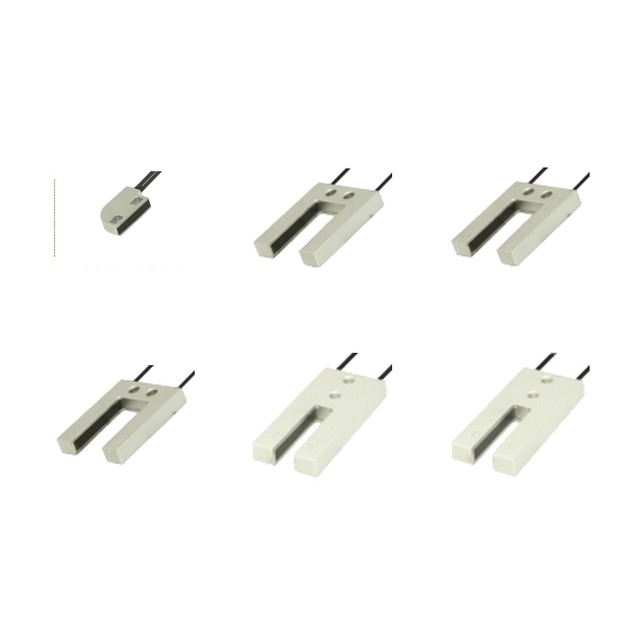
A Ø1.5 mm diffuse unit on the end of a slim arm, LE-021N at 250 µs, counting slots as the arm traverses. Area mode removes the false counts from the cassette ribs.
| Type | Fiber amplifier with separate fiber unit, open-collector output |
|---|---|
| Light source | 650 nm red LED, two elements |
| Response time | LE-021N: 60 µs (P100) · 250 µs (P101) · 500 µs (P102) · 1 ms (P103). LE-025N: 50 µs (P100) · 250 µs (P101) · 500 µs (P102) · 1 ms (P103) · 4 ms (P104) · 16 ms (P105) · 16 µs (P106) |
| Mutual interference | Cascade connector on the expansion models |
| Area mode | Yes — the beam can be averaged over a region instead of a spot |
| Output selection | LIGHT-ON / DARK-ON, switchable |
| Delay function | OFF-delay / ON-delay / single-shot timer, 1–9999 ms |
| Protection | Reverse polarity, output surge, over-current, ESD |
| Control output | Open collector 24 V, 100 mA max, residual voltage ≤1 V |
| Display | Two 4-digit displays: threshold (green) and real-time value (red) |
| Useful functions | Parameter initialisation, key lock, two-point teach, auto / manual teach, fast saturation reset |
| Supply voltage | 12–24 V DC ±10 %, ripple (P-P) ≤10 % |
| Power consumption | NPN 900 mW normal / 800 mW eco at 24 V · PNP 950 mW / 850 mW |
| Ambient temperature | −20 to +55 °C, 35–85 %RH, no condensation |
| Ambient light | Incandescent 20,000 lux · sunlight 30,000 lux |
| Vibration / shock | 10–55 Hz, 1.5 mm amplitude, 2 h in X, Y, Z · 500 m/s², 3 times in X, Y, Z |
| Housing material | Polycarbonate |
| Dimensions | 33.9 mm (H) × 11.2 mm (W) × 75 mm (D) |
| Weight | Approx. 90 g including the 2 m cable |
| Item | Value |
|---|---|
| Body width | 10.7 mm |
| Body depth | 81.2 mm (77.7 mm without the front cover) |
| Display window | 36.0 mm wide, 24.0 mm from the cable end |
| Fiber port | Ø4.0 mm bore, 7.7 mm centre height |
| Mounting | M3 screw through the side slot, or the DIN-rail bracket |
| Cable | 2 m, 4-core, flying lead |
The fiber port sits 7.7 mm above the base, so a unit approaching from below needs that much clearance under the amplifier. Two amplifiers butt together with no gap.
| Core | Colour |
|---|---|
| 2 | Blue |
| 3 | Black |
| 4 | White |
A 2 mm part crossing the beam at 1 m/s is inside the beam for 2 ms: P103 (1 ms) is enough. A 0.3 mm wire needs P100. Slower modes average more light and tolerate dust — use them when the machine is dirty, not when it is fast.
More than one pair facing the same direction means the LE-025N, whose white-core chain allows four adjacent units. A single beam anywhere on the machine takes the LE-021N.
The two versions are separate part numbers (LE-021N / LE-021P), not a wiring option — the output transistor is on the low or the high side of the load.
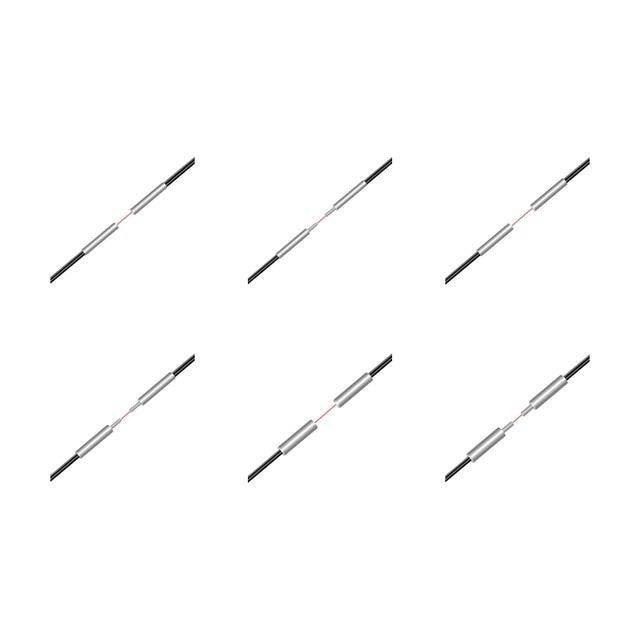
Diffuse for a part that can reflect, through-beam for a part that cannot, high-temperature where the beam passes a drying oven or a weld seam. All units in this chapter plug into the same port.
Threshold on the green display and the live value on the red one. An operator can see that a part is at 3,850 against a threshold of 2,010 without opening a menu — which is how a marginal detection gets caught before it becomes a stoppage.
LE-021N and LE-025N share the 33.9 × 11.2 × 75 mm envelope and the same bracket, so a machine designed around one accepts the other when the line speed changes.
On the LE-025N the white core carries the interference-control signal; four units can be stacked without alternating trigger timing, which is what a multi-lane feed actually needs.
Two-point teach, full-auto teach and manual entry from the front keys. The saturation-reset function recovers a signal that has drifted after a long run in a dusty cell.
Yes — one amplifier per unit, or one amplifier per through-beam pair (the emitter and receiver of a through-beam unit are two fibers into one amplifier). The amplifier supplies the light and does the switching; the unit is passive.
Three things: the LE-025N adds three faster modes (16 µs, 4 ms, 16 ms beyond the shared set), it suppresses interference between four adjacent units, and it lists 50 µs instead of 60 µs as its fastest mode. The body, the bracket and the wiring are identical.
The unit is what sees the heat — up to 350 °C at the fiber tip on the stainless types. The amplifier must still stay inside −20 to +55 °C, so the fiber is routed out of the oven to a cabinet-mounted amplifier. 1 m and 2 m fiber lengths are the standard options.
Check the output mode (LIGHT-ON against DARK-ON) before anything else: a diffuse unit on a shiny part returns more light than the threshold, and in LIGHT-ON that is the switching state. The second most common cause is a threshold taught with no part present.
Send your application details or the guard opening dimensions and we will specify the right model and configuration for your machine.