Wire and cable feed counting
A 0.6 mm wire through the 6 mm bore is counted once per pass, at 1 kHz, without a mechanical wheel.

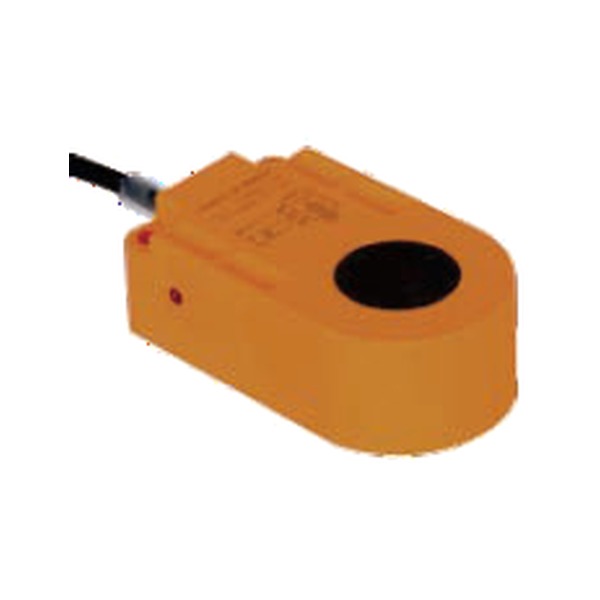
A coil around a hole: anything metal that passes through is counted, down to a 0.4 mm wire, regardless of where in the bore it passes.
Model LJR-06 / LJR-08 / LJR-10 / LJR-12 / LJR-19 / LJR-21 · Brand LE Raun · Category: Proximity Sensors
A ring sensor is a coil wound around a hole. Anything magnetic that passes through the hole changes the field, so the sensor counts it — regardless of where in the bore it passes, how fast it moves or whether it is round. That is what makes it the standard answer for wire, springs, needles and small fasteners, where a barrel sensor would need a precise gap and a photoelectric one would need a clear line of sight.Six bore sizes run from 6 mm to 21 mm. Always choose the smallest bore the part can pass through: the field is strongest at the centre and the minimum detectable object grows with the bore.All versions are 10 – 30 V DC, 1 kHz, under 1 ms response, ABS housing, IP67, with an orange status LED and NPN or PNP output.
A 0.6 mm wire through the 6 mm bore is counted once per pass, at 1 kHz, without a mechanical wheel.
The part passes through the ring and is counted regardless of orientation — the case a photoelectric sensor keeps missing.
A 21 mm bore sits under the feed tube and counts each fastener as it falls.
A missing pulse means the wire broke; the 1 ms response stops the machine before the next cycle.
Bore 8 mm counts cannulas as they pass, with no contact and no wear.
| Series | LJR-06 · LJR-08 · LJR-10 · LJR-12 · LJR-19 · LJR-21 |
|---|---|
| Inner bore size | 6.0 · 8.0 · 10.0 · 12.0 · 19.0 · 21.0 mm |
| Minimum detectable object | 0.4 mm ±1 % |
| Detected object | Magnetic metal |
| Response frequency | 1 kHz |
| Response time | < 1 ms |
| Housing | ABS, flame-retardant |
| Indicator | Orange (red) LED |
| Ambient temperature | −25 °C – +70 °C |
| Operating voltage | 10 – 30 V DC |
| Repeat accuracy | < 5.0 % (Sr) |
| Output | NPN (blank suffix) or PNP (P suffix) |
| Protection | IP67 |
| Current consumption | ≤10 mA |
| Output current | ≤200 mA |
| Voltage drop | ≤1.5 V |
| Switching frequency | 0.5 – 5 kHz depending on size |
| Hysteresis | ≤0.05 mm of the sensing distance |
| Circuit protection | Short-circuit, overload, reverse polarity |
| Cable | 2 m PVC, 3 × 0.2 mm², oil-resistant |
| Item | Value |
|---|---|
| Body | 35 × 60 × 16 mm (all bore sizes) |
| Mounting holes | 45.5 mm pitch, M4 |
| Cable | 2 m, 3-core |
The body is common to all six bore sizes; only the bore changes, which is what makes a changeover a matter of one screw.
| Lead | Colour |
|---|---|
| 2 | Blue |
| 3 | Black |
| — | Two-wire types |
A shielded (flush) sensor can be embedded in metal with only its face exposed, at about 60 % of the unshielded range. An unshielded sensor needs a free zone around the barrel but reaches further.
Order at least 1.5 × the nominal distance to allow for tolerances, temperature and target material. Non-ferrous targets — brass, aluminium, copper, stainless — reduce the distance to roughly 30–50 %.
The target should be at least as large as the sensing face. A smaller target reduces the distance proportionally, so a 4 mm target on an M18 sensor will not switch at 5 mm.
NPN / PNP, NO / NC, 3-wire or 2-wire. Plastic barrel for general use, stainless for weld fields, PTFE-faced for weld spatter, high-temperature types up to 120 °C.
The field fills the whole bore, so a thin wire, a needle or a spring is detected wherever it passes through — no alignment, no focal spot.
Because the field is the bore, the part can run off-centre, vibrate or change diameter and still be counted once.
6, 8, 10, 12, 19 and 21 mm — pick the smallest bore the part will pass through, which gives the strongest signal.
Fast enough to count parts on a high-speed feed track without a gap.
No — the field fills the bore. Off-centre passage still triggers it, which is why it works on a vibrating feed track.
No. Two parts in contact pass as one object. If you need to separate them, keep a gap of at least the part diameter between them.
No — this is an inductive sensor, magnetic metal only. For non-metal parts through a bore, use a capacitive sensor or a fibre-optic fork.
 Ultra-Thin Flat Inductive Proximity Sensors (5 – 10 mm thick)Proximity Sensors
 Ultra-Short Inductive Proximity Sensors (15 – 28 mm body)Proximity Sensors
 Ultra-Compact Inductive Proximity Sensors (φ3 to M6)Proximity Sensors
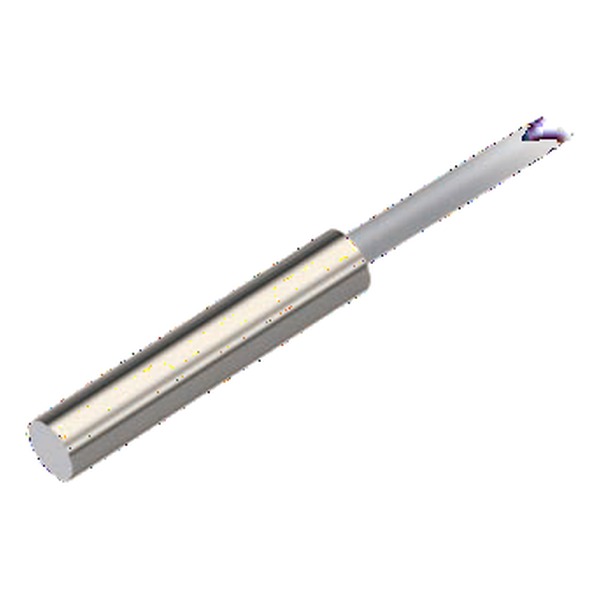 Standard Inductive Proximity Sensors, Short Barrel (M6.5 – M30)Proximity Sensors
Send your application details or the guard opening dimensions and we will specify the right model and configuration for your machine.